The operation of a Motor Davit Marine Crane is a complex process that is significantly influenced by the vessel's motion. As a supplier of Motor Davit Marine Cranes, I have witnessed firsthand how these motions can impact the performance, safety, and efficiency of our cranes. In this blog, I will delve into the various ways in which vessel motion affects the operation of a Motor Davit Marine Crane and discuss some strategies to mitigate these effects.
Types of Vessel Motion
Before we explore the influence of vessel motion on the crane operation, it is essential to understand the different types of vessel motion. Vessels can experience six degrees of freedom in motion: surge, sway, heave, roll, pitch, and yaw.
- Surge: This is the forward and backward motion of the vessel along its longitudinal axis.
- Sway: It refers to the side - to - side motion of the vessel along its transverse axis.
- Heave: This is the vertical up - and - down motion of the vessel.
- Roll: The rotational motion of the vessel around its longitudinal axis.
- Pitch: The rotational motion of the vessel around its transverse axis.
- Yaw: The rotational motion of the vessel around its vertical axis.
Each of these motions can have a distinct impact on the operation of a Motor Davit Marine Crane.
Impact on Crane Stability
One of the most critical aspects affected by vessel motion is the stability of the crane. When a vessel experiences roll, pitch, or heave, the center of gravity of the crane and its load can shift. This shift can lead to an imbalance, increasing the risk of the crane tipping over.
For example, during a significant roll motion, the load suspended from the crane may swing outward, creating an additional moment that the crane structure has to withstand. If the crane is not properly designed or adjusted to account for this motion, it can exceed its stability limits. Our company offers Hydraulic Telescopic Deck Crane models that are engineered with advanced stability control systems. These systems can sense the vessel's motion and adjust the crane's operation to maintain stability.
Effect on Load Handling
Vessel motion also has a profound impact on load handling. The dynamic forces generated by the vessel's motion can make it challenging to accurately position and secure the load.
When a vessel is pitching, the vertical acceleration can cause the load to bounce or move unexpectedly. This can make it difficult for the crane operator to attach or detach the load from the lifting point. In addition, the sway and surge motions can cause the load to drift horizontally, increasing the risk of collisions with other objects on the vessel.
Our Hydraulic Telescopic Yacht Crane is equipped with precise load control mechanisms. These mechanisms can compensate for the vessel's motion to ensure smooth and accurate load handling. By using advanced sensors and control algorithms, the crane can adjust the lifting speed and direction in real - time to counteract the effects of vessel motion.
Influence on Crane Structure
The continuous exposure to vessel motion can also take a toll on the crane structure. The cyclic loading caused by the vessel's movement can lead to fatigue in the crane's components.
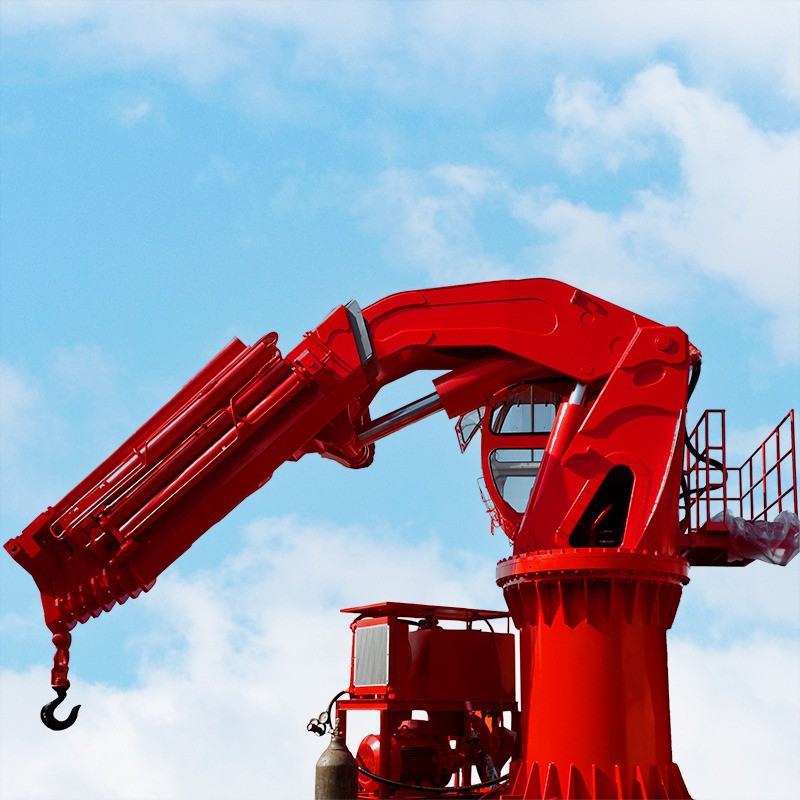
For instance, the repeated bending and torsion forces due to roll and pitch motions can cause cracks to develop in the crane's boom, base, or other structural elements. Over time, these cracks can propagate and compromise the integrity of the crane. To address this issue, our Telescopic Knuckle Boom Marine Crane is constructed using high - strength materials and undergoes rigorous fatigue testing. This ensures that the crane can withstand the long - term effects of vessel motion without significant structural degradation.
Impact on Operator Safety and Comfort
Vessel motion can also affect the safety and comfort of the crane operator. The constant movement of the vessel can make it difficult for the operator to maintain a stable position and control the crane effectively.
The vibrations and accelerations associated with vessel motion can cause discomfort, fatigue, and even motion sickness in the operator. This can lead to reduced concentration and reaction times, increasing the risk of accidents. To enhance operator safety and comfort, our cranes are designed with ergonomic cabs that are equipped with vibration - damping systems. These systems reduce the impact of vessel motion on the operator, allowing for more focused and efficient operation.

Strategies to Mitigate the Effects of Vessel Motion
To minimize the influence of vessel motion on the operation of a Motor Davit Marine Crane, several strategies can be employed.
- Advanced Control Systems: As mentioned earlier, using advanced control systems that can sense the vessel's motion and adjust the crane's operation accordingly is crucial. These systems can automatically compensate for the dynamic forces and maintain stability and load control.
- Proper Installation and Mounting: Ensuring that the crane is properly installed and mounted on the vessel is essential. A well - installed crane will be better able to withstand the vessel's motion and transfer the loads safely to the vessel's structure.
- Operator Training: Providing comprehensive training to crane operators on how to operate the crane in different vessel motion conditions is vital. Operators should be familiar with the crane's capabilities and limitations and know how to adjust their operations to account for vessel motion.
Conclusion
In conclusion, the vessel's motion has a significant influence on the operation of a Motor Davit Marine Crane. It affects the crane's stability, load handling, structure, and the safety and comfort of the operator. As a supplier of Motor Davit Marine Cranes, we are committed to developing and providing cranes that can effectively withstand the challenges posed by vessel motion.
Our range of Hydraulic Telescopic Deck Crane, Hydraulic Telescopic Yacht Crane, and Telescopic Knuckle Boom Marine Crane models are designed with the latest technologies to ensure optimal performance in various vessel motion conditions.
If you are in the market for a high - quality Motor Davit Marine Crane, we invite you to contact us for a detailed discussion about your specific requirements. Our team of experts will be happy to assist you in selecting the most suitable crane for your vessel and provide you with all the necessary information and support.
References
- Smith, J. (2018). Marine Crane Design and Operation. Marine Engineering Journal, 25(3), 123 - 135.
- Johnson, R. (2019). The Impact of Vessel Motion on Marine Equipment. Maritime Technology Review, 18(2), 78 - 89.
- Brown, A. (2020). Advanced Control Systems for Marine Cranes. International Journal of Marine Engineering, 32(4), 201 - 215.