

What's the Electro-hydraulic Clamshell Grab?
Electric-Hydraulic Grab for Powder & Fine Bulk Materials
This electric-hydraulic grab is specifically engineered for the efficient handling of powder and fine bulk materials, including but not limited to chemicals, fertilizers, grain, coal, coke, iron ore, sand, construction aggregates, and crushed rocks. Its versatile design makes it an ideal solution across a wide range of industries-from ports, steel plants, and power stations to ships and waste-to-energy plants.
The grab operates seamlessly with various lifting equipment, including tower cranes, ship cranes, ship unloaders, traveling cranes, and other standard crane types. Equipped with a self-contained hydraulic system, it features internationally renowned key components (imported from leading European and American brands), ensuring superior reliability, high operational efficiency, and extended service life even under the most demanding working conditions.
Designed for performance and durability:
Simple, robust construction – facilitates easy maintenance and trouble-free operation.
Stable performance in harsh environments – capable of withstanding high dust, moisture, and extreme temperatures.
Adjustable spill plate – allows for quick grad volume changes to accommodate materials with bulk densities ranging from 0.9 t/m³ to 3.0 t/m³, offering exceptional flexibility for multi-material handling.
Whether you are handling light agricultural products or heavy ores, this grab delivers consistent, high-throughput performance with minimum downtime.
What's the Electric-hydraulic Orange Peel Grab?
This electric-hydraulic grab is purpose-built for the efficient handling of blocky, granular, and irregularly shaped bulk materials-including coke, pig iron, steel scrap, slag, municipal solid waste, and rocks. Its rugged construction and specialized jaw designs make it the preferred choice for the most demanding material handling environments.
The grab finds wide application across ports, steel mills, scrap processing yards, and waste-to-energy plants. It is fully compatible with tower cranes, ship unloaders, traveling cranes, and other standard lifting equipment, offering seamless integration into existing material handling systems.
Engineered for reliability and performance: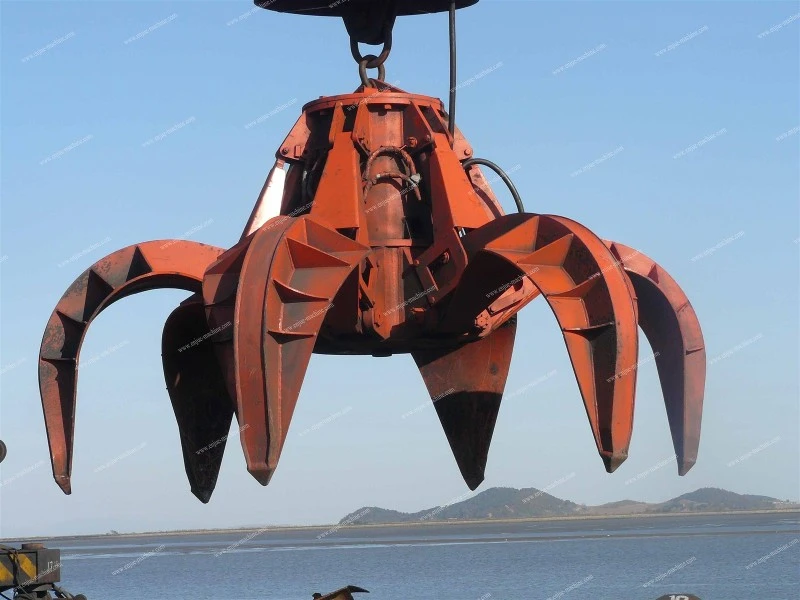
Self-contained hydraulic system – features key hydraulic components sourced from leading international brands (Europe/U.S.), ensuring consistent high output, rapid cycle times, and exceptional durability under continuous heavy-duty operation.
Robust and straightforward design – the simple mechanical structure minimizes maintenance requirements and allows for quick, hassle-free servicing even in harsh industrial environments.
Superior clamping force – optimized jaw geometry and hydraulic power deliver strong, reliable grip on materials of varying shapes and densities, reducing spillage and maximizing payload per cycle.
From handling hot slag in steel plants to grappling with bulky scrap metal at recycling facilities, this grab is built to keep your operations running efficiently, safely, and profitably.
Core Components of The Electric-hydraulic Grab
A typical electro-hydraulic grab bucket consists primarily of the following components:
Shell/Body: Serves as the overall structural framework.
Grab Shells/Jaws: The components that make direct contact with the material; these can be configured as two-shell, multi-shell, or other types.
Hydraulic Cylinders: Hydraulic actuators that perform the opening and closing actions.
Electric Motor: Provides power.
Hydraulic Pump Station: Comprising the hydraulic pump, valve assembly, oil tank, etc.; this serves as the core of the entire hydraulic system.
Main Types and Application Scenarios of Electro-Hydraulic Grabs
Depending on their structural configuration and application scenarios, electro-hydraulic grabs can be classified into the following main types:
| Type | Structural characteristics | Main Application |
|---|---|---|
| Electric-hydraulic Clamshell Grab | Symmetrical two-piece structure with high versatility. | Designed for use with single-hook cranes to handle various types of bulk cargo (such as yellow sand, coal, ore, and cement); commonly used on ships and at terminals. |
| Electro-hydraulic Orange Peel grab | Multi-petal structure (typically 4–8 petals) with evenly distributed gripping force. | Used for grabbing irregular materials such as municipal solid waste and scrap steel; commonly employed in environmental protection power plants and steel mills. |
| Electric-hydraulic Timber Grab | The petal edges feature a serrated structure. | Loading and unloading logs; commonly used in timber yards and at wharves. |
Depending on the density of the material being handled, the capacity of electro-hydraulic grabs typically ranges from 0.6 m³ to 35 m³, making them suitable for cranes with lifting capacities ranging from 3 to 80 tons.
Why Choose Electro-Hydraulic Grabs? - Electric-hydraulic Grab VS Clamshell Grab
Compared to traditional rope-operated mechanical grabs, electro-hydraulic grabs offer significant technical advantages:
High Controllability
Traditional mechanical grabs rely on the winding and unwinding of wire ropes for opening and closing, making precise control of gripping force impossible. In contrast, electro-hydraulic grabs utilize a hydraulic system to enable precise adjustment of gripping force; the force can be flexibly adapted to material characteristics, preventing material slippage or grab overload.
High and Stable Gripping Force
The hydraulic system delivers powerful, stable grab force, easily handling heavy-duty material operations. A hydraulic servo system automatically adjusts pump flow based on pressure fluctuations; when maximum pressure is reached, pump flow drops to a minimal level, significantly reducing overflow losses, energy consumption, and oil temperature, thereby supporting 24-hour continuous operation.
Strong Adaptability
Electro-hydraulic grabs operate reliably in extreme environments, such as those with high dust levels, high temperatures, or underwater conditions. Key components of the hydraulic system-such as main valve blocks and seals-are primarily sourced from European and American brands, ensuring system reliability.
Potential for Smart Integration
In recent years, electro-hydraulic grabs have begun incorporating advanced technologies like energy recovery systems and intelligent controls, further enhancing operational efficiency and energy-saving capabilities.


An Overview of the Capabilities of China's Leading Electro-Hydraulic Grab Manufacturers
Shanghai ENJUE Machinery Equipment Co., Ltd. is a comprehensive enterprise focusing on the fields
of harbor, marine, and non-standard machinery, integrating research and development, design,
manufacturing, sales, and service.
With an experienced technical team and advanced production equipment, the company is committed to providing customers with high-quality and high-efficiency solutions, including all kinds of grabs, customized container spreaders, dust removal funnels, packaging equipment, and a variety of types of cargo loading machinery, including comprehensive solutions.
How to Select a Chinese Manufacturer of Electro-Hydraulic Grabs?
When selecting an electro-hydraulic grab, it is recommended to comprehensively evaluate the manufacturer's capabilities based on the following criteria:
Technical R&D Capabilities
Do they possess core patented technologies?
Does the hydraulic system utilize components from international brands (e.g., European or American valve assemblies and seals)?
Do they have the capability to customize products for specialized operating conditions (such as underwater, high-temperature, or high-dust environments)?
Manufacturing and Quality Control Systems
Are they certified under quality management systems such as ISO9001?
Do they possess large-scale machining equipment and comprehensive inspection and testing facilities?
Have they obtained certifications from international classification societies such as LR, CCS, ABS, DNV, or BV?
Electric-hydraulic Performance Metrics
Do parameters such as electric-hydraulic grab capacity, deadweight, and motor power align with operational requirements?
What is the Mean Time Between Failures for continuous operation?
Do energy-saving features (such as energy recovery systems) meet environmental protection standards?
Industry Application Experience
Do they have successful case studies in relevant sectors (such as ports, steel mills, waste-to-energy plants)?
Have they participated in landmark projects?
After-Sales Service Capabilities
Do they provide technical support and on-site services?
Is the supply of spare parts timely and reliable?


