

In industries such as building materials, chemicals, grain, and animal feed, the containerized bagging machine is a critical piece of equipment at the end of the production line. Its stable operation directly impacts shipping efficiency, packaging accuracy, and operating costs. However, maintenance strategies in many factories still require improvement. A scientific and systematic maintenance checklist serves as a foundational tool to help equipment managers transition from "reactive repair" to "proactive prevention."
Why is a maintenance checklist necessary?
Containerized bagging machines typically operate in harsh environments characterized by high dust levels, continuous operation, and frequent start-stop cycles. The absence of a standardized checklist can lead to:
Oversights in inspection items, resulting in critical components (such as load cells and bag-clamping mechanisms) being neglected over the long term;
Disorganized maintenance schedules, with tasks like lubrication, cleaning, and calibration performed haphazardly;
Difficulty in diagnosing faults due to a lack of historical records, making it impossible to analyze the containerized bagging machine health trends.
A standardized maintenance checklist clarifies what needs to be done, when, by whom, and how, effectively transforming maintenance expertise into repeatable processes.

Level 1: Routine Inspection (per shift/daily)
Routine inspections serve as the first line of defense in preventive maintenance; they are performed by operators before startup, during operation, and after shutdown, taking approximately 5 to 10 minutes.
| Inspection Area | Checking Item | Criteria for determination |
|---|---|---|
| Pneumatic system | Compressed air pressure | 0.5–0.7 MPa, no leakage |
| Bag-clamping mechanism | Sealing integrity of the bag opening | No material leakage; clamping action is crisp and decisive. |
| Weighing System | Instrument zero drift | Stable zero return under no-load conditions. |
| Feeding mechanism | Feed gate/impeller operating noise | No abnormal noise or binding. |
| Safety device | Emergency stop button, safety door switch | Movements are agile and effective. |
| Dust removal system | Dust collector negative pressure | No significant dust leakage at the suction inlet. |
Operational Guidelines: When starting up the machine at the beginning of each shift, it is recommended to perform 2–3 manual dry-run cycles to verify that the sequence of operations is functioning correctly.
Level 2: Periodic Maintenance (Weekly/Monthly)
Maintenance technicians perform periodic maintenance and involves more in-depth cleaning, lubrication, and parameter verification.
Weekly Maintenance Tasks:
Lubrication: Apply lithium-based grease (No. 2) to moving parts such as cylinder pivot points, spherical bearings, and chains; ensure that different brands or types of grease are not mixed.
Load Cell Inspection: Clean away accumulated dust around the load cells and inspect cables for signs of wear, abrasion, or deformation due to crushing.
Bag Magazine Inspection: Check the tension of the bag-feeding belt of the containerized bagging machine and clear any spilled material from the bag magazine area to prevent bag jams.
Pneumatic System Drainage: Drain accumulated water from the air service unit (FRL unit) and check the oil level in the lubricator.
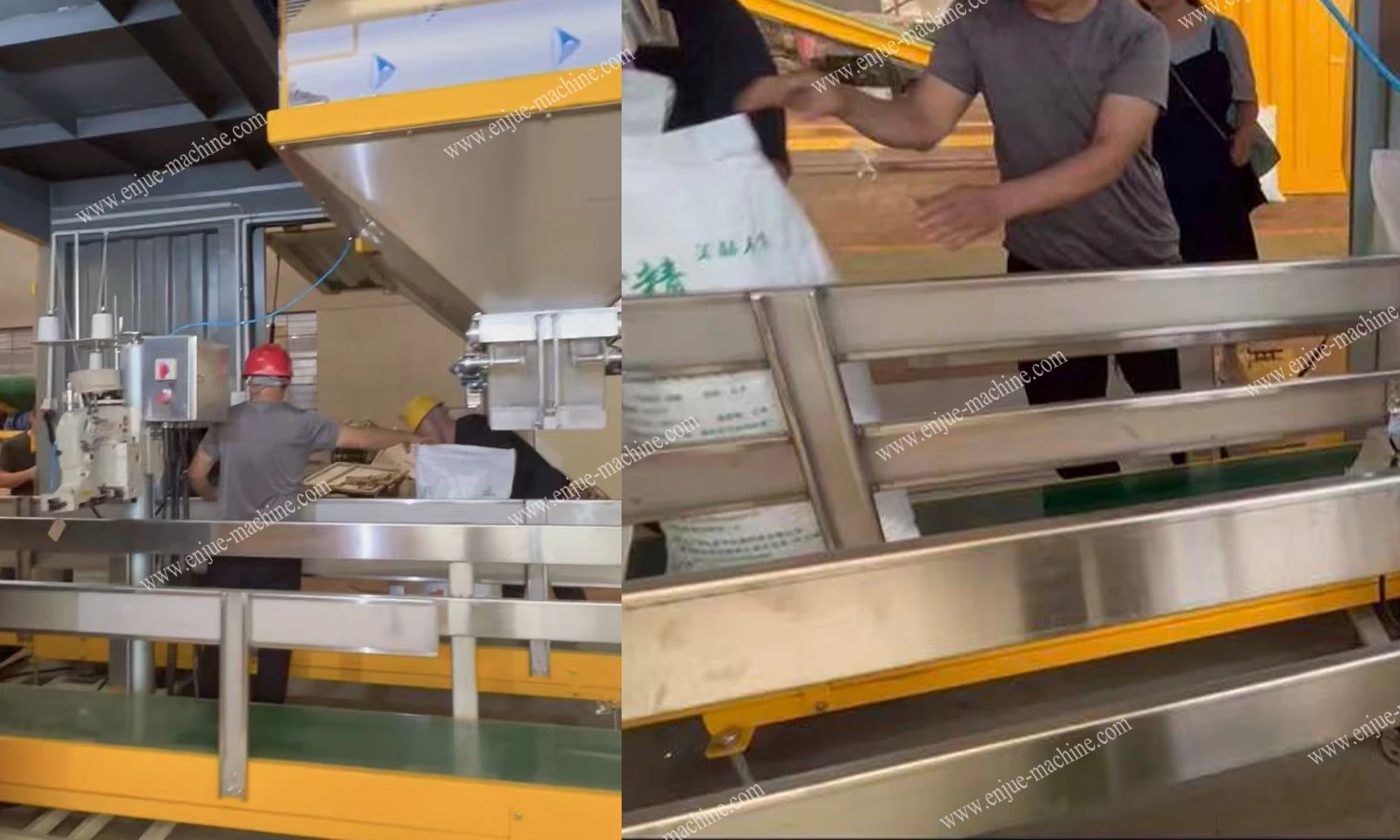
Monthly Maintenance Tasks:
Weighing system calibration: Perform span calibration using standard weights and verify that linearity and repeatability errors fall within permissible limits (typically ≤±0.2%);
Bag-clamping pad inspection: Check the wear on the bag-clamping sealing pads; flip or replace them if wear is severe to ensure uniform clamping force;
Fastener inspection: Focus on the mounting bolts for the weigh hopper, support frame, and load cells to prevent loosening that could cause measurement errors;
Electrical terminal inspection: With the main power of the containerized bagging machine disconnected, check the tightness of the terminal blocks inside the control cabinet to prevent signal interference caused by poor contact.
Level 3: Major Maintenance (Semi-annual/Annual)
Major maintenance is typically performed during the production line's annual overhaul and involves comprehensive disassembly, inspection, and the replacement of critical components.
Key Semi-annual/Annual Tasks:
Load cell performance assessment: Use a multimeter to measure the sensor bridge impedance and insulation resistance to check for signs of aging or moisture ingress;
PLC/instrument battery replacement: Replace controller backup batteries to prevent the loss of programs or parameters;
Feeding mechanism wear inspection: Disassemble and inspect the feed screw or impeller, measure the clearance between the impeller and the housing, and replace worn parts if they exceed standard tolerances;
Comprehensive seal replacement: Periodically replace rubber components-such as cylinder seals and rotary joint seals-that are prone to aging, to prevent pneumatic leaks;
Overall accuracy testing: Conduct a continuous run of 50–100 bags using a standard package weight; calculate the average error and standard deviation to evaluate the containerized bagging machine's overall capability index.
Three Keys to Successfully Implementing Maintenance Checklists
1. Digitization and Standardization
Paper-based checklists are easily overlooked or falsified. It is recommended to use digital forms (such as the inspection modules in WeCom or DingTalk) equipped with built-in photo and geolocation capabilities to ensure that every inspection is genuinely performed. Additionally, the system should automatically generate a maintenance history log to facilitate traceability.
2. Integration with Spare Parts Inventory
Maintenance checklists should specify the models or specifications of wear parts associated with each inspection item (cylinder models, sensor specifications, or filter element types). When an anomaly is detected, maintenance personnel can instantly access the relevant spare parts information from the checklist to quickly request replacements, thereby minimizing downtime.
3. Closed-Loop Management of Anomalies
A checklist should serve not merely as a tool for "checking boxes," but as a channel for reporting issues. Each inspection item of the containerized bagging machine should include "Normal/Abnormal" options; detecting an anomaly should automatically trigger a maintenance work order, establishing a closed-loop process comprising detection, reporting, analysis, resolution, and verification.
Common Faults and Maintenance
| Common Fault Symptoms | Possible causes | Corresponding preventive maintenance items in the maintenance checklist |
|---|---|---|
| Significant fluctuations in packaging weight | Sensor zero-point drift or unstable operation of the feed gate. | Daily zero-point check + Monthly calibration |
| Frequent bag dropping during the bagging process | Wear on the pouch-clamping rubber pads or insufficient cylinder pressure. | Monthly bladder and rubber plate inspection + daily air pressure monitoring |
| Feed rate decreases | Impeller/scroll wear or low air path pressure | Annual wear inspection + routine air supply check |
| Control system freeze or malfunction | Electromagnetic interference or poor terminal contact | Monthly electrical terminal tightening and grounding system inspection |


