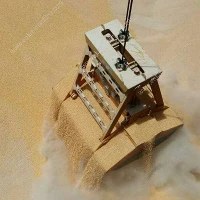
As a grab bucket supplier serving port terminals, ship owners, bulk yards and recycling operators, this is the question we get almost every week. Both grabs rely on hydraulic power to open and close the jaws, but their power supply, crane compatibility, working logic and suitable scenarios are totally different. Picking the wrong type will lead to high retrofit cost, low throughput, frequent downtime and safety risks.
What Is a Remote Control Grab?
A remote control grab (radio remote hydraulic grab) is battery-powered, self-contained grab. It hangs directly on a single-hook crane, deck crane or mobile harbour crane. No hydraulic hoses, no power cables, no cable reel on the crane is required. It closes by self-weight when it touches the material pile. The operator sends a wireless signal to open the grab at any position in the air. The grab comes with built-in battery, hydraulic station and wireless receiver. It supports partial opening, so you can discharge material slowly, reduce dust and avoid impact on hoppers or barges. It is plug-and-play: hook it on and start working immediately, perfect for vessels that move between different ports frequently.

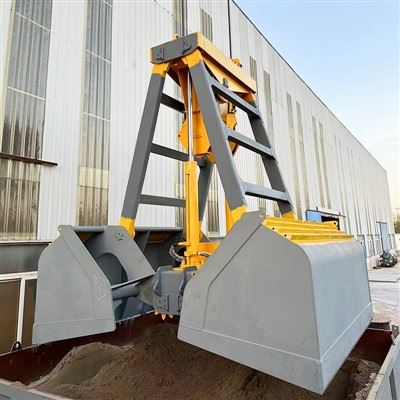

What Is a Standard Hydraulic Grab (Electro-Hydraulic Grab)?
The electro-hydraulic grab gets continuous power and hydraulic supply from the crane. It depends on the crane's cable reel or hydraulic circuit. It delivers constant, powerful closing force independent of self-weight. It can bite into compacted ore, sticky bulk, scrap metal and large lump materials. It runs continuously 24/7 without worrying about battery charging. Many models support 360-degree rotation, widely used on excavators, gantry cranes and fixed shore cranes at dedicated bulk terminals.
Core Comparison: Remote Control Grab vs Hydraulic Grab
1.Crane requirement Remote control grab: Works on single hook / single drum crane. No crane modification, no cable reel needed. Great for ship deck cranes. Hydraulic grab: The crane must be equipped with power cable reel or hydraulic pipeline. Retrofit is required if your crane does not have this configuration.
2.Gripping force and material Remote control grab: Closing force relies on grab dead weight. Best for free-flowing bulk: grain, fertilizer, sand, coal, powder, wood chips. Hydraulic grab: Constant hydraulic closing force. Strong penetration force. Suitable for iron ore, nickel ore, compacted bulk, scrap steel, waste, sticky materials.
3.Operation and discharge control Remote control grab: Wireless remote control, adjustable partial opening. Gentle discharge, low dust, less spillage. Good for dust control and hold cleaning. Hydraulic grab: Cab-controlled, fast full opening. High cycle speed for heavy-duty continuous unloading.
4.Continuous working limit Remote control grab: Limited by battery life. Need periodic charging. Ideal for intermittent operation, multi-port ship operation. Hydraulic grab: Unlimited continuous running, stable power supply for round-the-clock terminal discharge.
5.Maintenance and ownership cost Remote control grab: Battery and wireless receiver need regular inspection. Low crane transformation cost, high flexibility. Hydraulic grab: More hydraulic hoses, cable reel and electrical components. Lower daily consumable cost after crane modification is done.
guide to select grab
✅ Choose Remote Control Grab if:
You use single-hook ship deck cranes or mobile cranes
Your vessel calls at multiple ports and you want quick hook change
You handle grain, fertilizer, sand, coal and powder cargo
Dust control and gentle unloading are required
You want to avoid expensive crane cable reel retrofit
✅ Choose Electro-Hydraulic Grab if:
You have shore gantry cranes, excavators with hydraulic/power supply
You unload heavy, compacted, sticky materials such as ore and scrap
You need 24-hour continuous high-volume unloading
You need 360° rotation and strong digging force
Conclusion
There is no "better" grab overall, only the more suitable one for your crane and cargo. If your crane is single hook and you often switch ports, the remote control grab brings unbeatable flexibility. If you run a fixed bulk terminal with heavy ore and continuous high throughput, the electro-hydraulic hydraulic grab is the reliable workhorse.
If you are not sure which one fits your unloading project, send us your crane type, cargo density and hourly target throughput. Our engineering team will recommend the correct grab capacity and configuration for you.
FAQ

01.Can a remote control grab handle heavy ore like iron ore?
02.Can we retrofit an old crane to use an electro-hydraulic grab?
03.What is the normal battery life for a remote control grab?
04.Does hydraulic grab support partial slow discharge?
05.Can one remote control grab be shared and used on multiple single-hook cranes?
06.What is the difference in maintenance cycle between these two grabs?