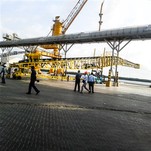
What is a Clamshell Grab?
A clamshell grab – also referred to as a clamshell bucket or clamshell attachment – is a mechanical device specifically designed for grabbing and handling bulk materials. It features two hinged, shell‑like jaws that open and close to grasp and release material. These grabs are typically mounted on cranes, excavators, or other types of lifting equipment.
They are widely applied in terminals, construction, mining, dredging, waste management and port operations for tasks including excavating, lifting and conveying loose materials such as soil, sand, gravel, minerals and waste. They cut manual labor, boost loading and unloading efficiency, lower labor costs, and can be directly integrated with existing crane facilities.
Grab Main Components
Grab Shells
As the core components of a clamshell grab, the two opposing half-shells open and close to capture bulk materials. Manufactured from high-strength steel or other wear-resistant materials, grab shells withstand heavy loads and abrasion from abrasive cargo.
Shell Design
Shell designs are divided into semi-closed type and fully closed type. Semi-closed shells are suitable for coarse materials, while fully closed shells are applied for fine materials or underwater operations.
Shell Edges
Shell edges can be straight or serrated. Serrated edges perform better for digging or handling hard materials, whereas straight edges fit soft materials or loose soil.
Teeth or Cutting Edges
Teeth or cutting edges can be fitted on grab shells based on working conditions. Teeth penetrate and break hard materials such as rock and compacted soil, while cutting edges are designed for softer substances like sand and loose earth.
Pivot Pins
Pivot pins connect the grab shells to hydraulic cylinders and the main body. They allow the shells to rotate around a fixed axis, enabling smooth, controlled opening and closing movements.
Wear Plates / Liners
To extend the service life of clamshell grabs, wear plates or liners can be installed inside the grab shells. Made of wear-resistant materials, these components shield the shells from direct contact with abrasive materials and minimize abrasion to the greatest extent.
Lifting Mechanism
The lifting mechanism serves as the connector that attaches the clamshell grab to a crane or excavator. It may consist of hooks, chains or other connecting fittings, depending on the specific equipment in use.
Working Pressure and Flow Rate
Hydraulic and electro-hydraulic clamshell grabs require specific working pressure and oil flow rate for normal operation. These technical parameters shall match the equipment they are attached to.
Why Choose a Clamshell Grab?
Wide Material Compatibility
It handles almost all types of loose bulk goods, including sand, coal, grain, ore, scrap metal, and waste – suitable for ports, construction sites, mines, and waste treatment facilities.
Simple Structure and Low Maintenance
With a compact hinged double‑shell design, there are fewer wear‑prone parts. Daily inspection and repair are straightforward, significantly reducing long‑term maintenance costs.
High Loading and Unloading Efficiency
The bucket opens and closes flexibly, enabling fast grabbing and precise dumping at any height. Continuous cyclic operation greatly improves handling speed compared with manual work.
Strong Crane Adaptability
Compatible with overhead cranes, gantry cranes, ship cranes, and excavators – no complex refitting required. It integrates seamlessly with existing crane equipment.
Optional Wear‑Resistant Structure
Grab shells can be fitted with wear plates, teeth, or cutting edges depending on working conditions, extending service life when handling abrasive and hard materials.
Principle of Operation
Our grabs are engineered with meticulous craftsmanship to deliver outstanding performance and long service life. The inner surfaces are fabricated from high‑quality drawn steel, facilitating the handling of various materials including mud and clay. The outer frame is reinforced with extra‑thick plates to resist abrasion and withstand harsh working conditions.
How Does It to Work
---Opening Cycle: Press the controller switch, send the message to the receiver, then the electromagnetism valve open the hydraulic circuit system, the hydraulic vat was extended because of the gravity of goods and down roof beam, the down roof beam was separated from moving board, to make the grab open , and the grab can do the next closing cycle.
---Closing Cycle: When the grab is opening, the moving board is connecting with top roof beam, and separate with down roof beam, at that time, the hydraulic circuit system is opening, and the piston of hydraulic vat was pulled out by moving board. When grab the goods, the hook of the crane go down, the moving board go down along the hydraulic vat with the piston of the cylinder, when the moving board touch the stroke switch on the down roof beam, the stroke switch stop the electromagnetism valve to stop the hydraulic oil . The hook of the crane goes up with moving board and down roof beam, to make the grab close.
Main Functions
The clamshell grab performs four core functions in bulk material handling operations:
Digging and scooping : penetrates material piles or seabeds to capture a fixed volume of materials.
Lifting and transporting : firmly holds the loaded material while the crane moves.
Precise discharging : accurately releases materials at target positions.
Recurring cyclic operation : reliably completes continuous high‑frequency loading and unloading work.
Type of Clamshell Grab VS Other Type of Grabs
| Grab Type | Power Supply | Handing Materials | Application Fields |
| Clamshell Grab Bucket | Hydraulic or Ropes | Grains, Coals,Sand, Rocks | Port,dredging, Power plant |
| Hydraulic Grab Bucket | Hydraulic | Bulk Cargo,Fertilizer,Lime powder |
fertilizer plant,Food factory |
| Orange Peel Grab Bucket | Hydraulic or Ropes | Scraps,Woods,lump ore | Scrap yards, Steel mills |
| Ropes Grab Bucket | Ropes | Loose bulk materials,Mud | Port cranes, Ship loading and unloading |
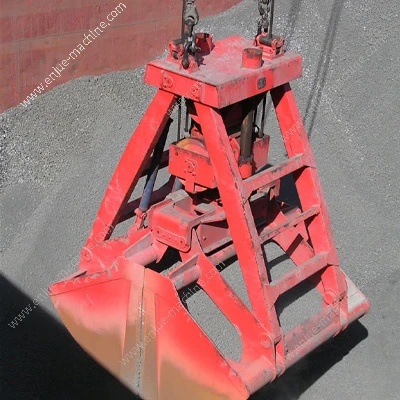


Clamshell Grab Application
Construction:In construction projects, clamshell grab buckets are used for excavation, trenching, and material handling. They work effectively with soil, sand, gravel, concrete debris, and other materials, making them ideal for site preparation and cleanup.
Mining:In mining operations, clamshell grabs are employed for material excavation and processing. They handle coal, ore, and overburden, facilitating efficient mineral extraction and transportation.
Dredging:Clamshell grabs are widely used in dredging to remove silt and debris from rivers, lakes, ports, and canals. The fully enclosed shell design is particularly suitable for underwater work, as it effectively prevents material leakage and water ingress.
Port and Vessel Operations:Clamshell grab buckets are deployed at ports and aboard ships for loading and unloading bulk materials such as coal, grain, and fertilizer. Mounted on cranes or masts, they enable efficient material handling in these demanding environments.
Waste Management:At waste management and recycling facilities, clamshell grabs handle a wide range of waste materials – including municipal solid waste, scrap metal, and biomass. They enable efficient sorting and transfer, streamlining recycling and processing workflows.
Forestry:In forestry applications, clamshell grabs are used to handle logs, wood chips, and other forest by‑products. Mounted on forest cranes or loaders, they deliver high‑efficiency material transport in demanding woodland environments.
Agriculture:For agricultural use, clamshell grabs process feed, grain, fertilizer, and similar materials. Mounted on loaders or tractors, they serve as versatile multi‑purpose tools for farming operations.
Landscaping:Clamshell grabs are widely used in landscaping for excavation, ground leveling, and material transport. They are well‑suited for moving soil, mulch, and other landscaping materials, helping construct and maintain attractive outdoor spaces.
How to Choose the Right Grab Bucket?
1.Material type and bulk density
Different materials impose distinct requirements on grab structure and capacity. For example:
Light bulk materials (grain, wood chips): Large‑volume clamshell grabs are recommended.
High‑density hard materials (ore, scrap steel): Orange peel grabs or rectangular grabs are required for stronger clamping force and superior wear resistance.
Long materials (logs): Special timber grabs with enhanced bundling and gripping performance shall be adopted.
2.Lifting Capacity of Cranes
Cranes must operate within their rated safe working load limits. For rope‑operated grabs, confirm the crane drum configuration as follows:
Single drum: Normally matched with ground‑operated grabs and remote control grabs.
Double drums: Suitable for two‑rope or four‑rope grabs.
Drums with power supply cables: Generally used with electro‑hydraulic grabs.
3. Operating Environment
Structural materials and drive modes shall be selected based on the operating environment:
Ports and open terminals: Electro‑hydraulic grabs are recommended. Their closed systems perform better under high humidity and salt spray conditions.
High‑temperature, low‑temperature, or corrosive environments: Corrosion‑resistant structures, low‑temperature‑resistant materials, and high‑temperature sealing components are adopted to ensure long‑term stable operation.
Confined spaces: Compact grabs with flexible rotation are preferred.
4.Efficiency and Grabbing Frequency
Grab capacity, opening/closing speed, and control mode directly determine operational rhythm.
High‑frequency continuous operation: Electro‑hydraulic grabs are recommended for their fast response and easy maintenance.
Medium and low‑frequency operation: Simplified mechanical grabs are available as a cost‑effective choice.
Automatic requirements for special processes: Intelligent control systems are suggested to enable remote operation and precise positioning.