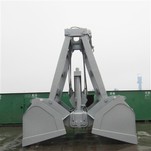
Design and Structure between davit crane and jib crane
Features a vertical mast with a tilting/swiveling boom (davit arm).
Often portable or pedestal-mounted, allowing limited rotation (typically 180° to 270°).
Uses a winch or manual/electric hoist for lifting.
Has a horizontal jib arm (fixed or rotating up to 360°) supported by a column, wall, or foundation.
The hoist travels along the jib, enabling precise load positioning within the jib's radius.
Usually fixed in place (wall-mounted, column-mounted, or free-standing).
Mobility
Often portable or semi-portable, suited for temporary or confined spaces (e.g., ships, docks, small construction sites).
Jib Crane:
Typically stationary, designed for repetitive use in industrial settings (e.g., factories, workshops).
Load Capacity and Reach
Lighter load capacities (often under 5 tons).
Limited reach, suited for localized tasks.
Higher load capacities (up to 20 tons or more).
Longer reach and broader coverage area (full 360° rotation).
Applications
Marine environments (launching/retrieving lifeboats, equipment).
Emergency use, confined spaces, or lightweight lifting (e.g., valves, pumps).
Industrial material handling (loading/unloading, machine servicing).
Repetitive tasks in factories, warehouses, or machine shops.