

In the urban sanitation system, the transfer station for household waste is the core hub connecting front-end collection and end-stage treatment (incineration/landfill). Every day, a large number of garbage compactor trucks enter the transfer station. How to quickly, in a closed manner, and without secondary pollution, dump the garbage into storage pits or onto conveyor belts is the bottleneck of the entire transfer efficiency.
1.Under traditional methods, the unloading process for a fully loaded garbage compactor truck (typically weighing 30~80 tons) requires manual guidance to position the vehicle, open the rear compartment, and wait for the garbage to slowly slide out. The entire process often takes 15~30 minutes or even longer. During peak hours in the morning and evening, multiple trucks arriving simultaneously is common, with queues forming inside the transfer station. In severe cases, there can be 5~8 vehicles in line, causing the entire transfer station to descend into paralyzing congestion.
In contrast, a dedicated hydraulic flip-plate unloading machine (such as the Enjue 40'container tilter with truck for unloading -100T) has a lifting cycle of only about 8~10 minutes, with fully automated operation throughout the process. After the vehicle drives onto the 17.5m×3.0m flip-plate platform, the operator presses a single button to start, and the platform automatically lifts to an adjustable angle of 0°~45°, allowing the garbage to quickly slide into the pit under the force of gravity. This increases the turnaround efficiency per vehicle by 3~5 times.
This means that a transfer station that could originally handle only 2~3 trucks per hour can handle 6~10 trucks after installation, directly relieving congestion during peak periods.
2. Severe Pollution: Garbage exposed to the air, wastewater dripping, and odor spreading
When garbage is exposed in an open state for a long time, it can trigger a series of serious environmental problems:
Wastewater dripping: Garbage contains a large amount of leachate. During traditional unloading, the liquid flows out along with the garbage and drips onto the ground, forming polluted water bodies that require additional cleaning.
Odor spreading: Organic matter in garbage rapidly volatilizes in the air, producing foul gases such as hydrogen sulfide and ammonia, affecting nearby residents' lives and even causing complaints.
Dust scattering: Dry garbage generates a large amount of dust during dumping, causing secondary pollution to operators and the surrounding environment.
The hydraulic container tilter with a truck for unloading adopts a closed rear-flip design. Garbage is flipped on a sealed platform and is never exposed to the air, eliminating the problems of wastewater spillage and odor spread from the source and fully meeting the sanitation industry's strict requirements for enclosed operations.
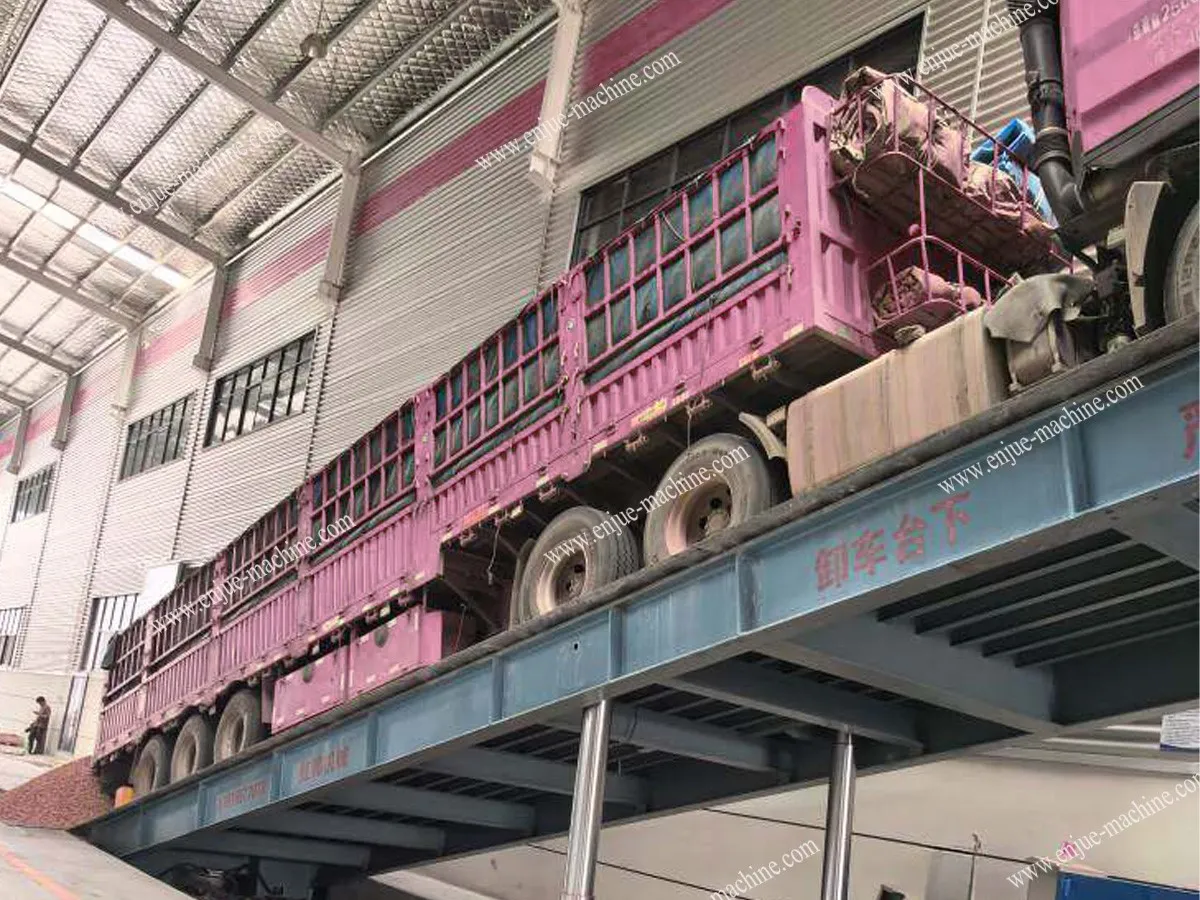
3. Safety Hazards: Manual operation near vehicles carries the risk of being crushed or caught in machinery
Traditional unloading methods require operators to work close to the vehicle, while the 40'container tilter with a truck for unloading themselves are extremely heavy (fully loaded, it can weigh tens of tons).
If the vehicle slips, rolls back, or an operational mistake occurs, the consequences can be catastrophic. Injuries such as crushing and entanglement caused by manual unloading are common in the industry.
Specialized unloading machines fundamentally eliminate this risk through the following methods:
Remote control operation: Using a remote control, the operator can complete all operations from a safe distance without having to stand on the platform or near the vehicle.
PLC automated control: The PLC human-machine interface allows one-button startup, and the platform automatically completes the full process of lifting, tilting, and lowering, reducing human intervention.
Multiple safety protections: High and low voltage electromagnetic overflow valves provide overload protection to prevent overpressure lifting; wheel stoppers prevent the vehicle from sliding on the platform.
Precisely because of this, an increasing number of urban sanitation authorities have listed hydraulic tipping unloaders as standard equipment for waste transfer stations, rather than as an optional choice.


