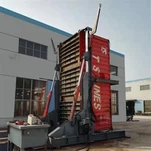
Against the backdrop of the accelerated global "dual carbon" goals, the shipbuilding industry is undergoing a profound transformation centered on green and low-carbon development. As a leading company in marine equipment manufacturing, ENJUE Group has successfully reduced energy consumption by over 30% through the large-scale application of lightweight materials in yacht lifting equipment. ENJUE yacht crane provides a replicable technological paradigm for the industry's green transformation.
 Lightweight Materials: The Key to Solving the Energy Consumption Dilemma in Yacht Hoisting
Traditional yacht crane hoisting equipment is primarily made of high-strength steel, with a density of up to 7.85g/cm³, resulting in equipment weights that often exceed 15 tons. During the hoisting process, the inertial force generated by the equipment's own weight significantly reduces the energy consumption of the yacht crane, becoming a key bottleneck restricting energy efficiency. The ENJUE R&D team has implemented material substitution technology to incorporate lightweight, high-strength materials such as aluminum alloy and fiberglass composite materials into the manufacturing of key components.
The use of aluminum alloy and fiberglass composite materials further breaks through weight limitations. In the manufacture of the rotating support for a 10-meter yacht crane, ENJUE yacht crane uses carbon fiber-reinforced polyetheretherketone (PEEK) composite materials, formed through a vacuum bagging process. This reduces the component weight by 65% compared to steel structures while maintaining a tensile strength of 1200 MPa. This technology increases the equipment's energy efficiency to 82% when operating at full capacity, 15 percentage points higher than the industry average.

Technological Breakthrough: From Material Substitution to System Optimization
ENJUE's yacht crane lightweighting revolution isn't simply a material replacement; it achieves a leap in energy efficiency through systematic innovation across materials, structures, and processes. In developing a 20-meter ultra-large yacht crane, the R&D team employed topology optimization technology to implement biomimetic designs for key components like the boom and base, increasing material utilization from 62% to 89%. Combined with laser welding, the number of welds was reduced by 70%, significantly minimizing energy loss caused by stress concentration.
Industry Resonance: Green Standards Reshape the Competitive Landscape
ENJUE's yacht crane technological breakthroughs are triggering a chain reaction across the industry. According to statistics from the China Shipbuilding Industry Association, the adoption rate of lightweight materials in domestic yacht lifting equipment has jumped from 12% in 2020 to 47% by 2024, driving an average annual reduction of 120,000 tons of carbon dioxide emissions across the industry. At Yantai Port in Shandong Province, a 69-ton yacht crane using ENJUE's lightweight technology has reduced single-vessel loading and unloading time to 2.3 hours, a 35% improvement in efficiency compared to traditional equipment.
In this green revolution, the ENJUE yacht crane is redefining the energy efficiency of yacht lifting equipment with lightweight materials. When technological innovation resonates with the "dual carbon" strategy, a new era of lighter, more efficient marine equipment is emerging.