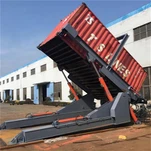
I. Structural Design and Load-Bearing System of the Container Tilter Standards
The steel structural system of the main unit serves as the container-tilter's framework; its strength, rigidity, and stability directly determine the service life of the entire machine. Design must adhere to the following core standards:
GB50017-2003 Code for Design of Steel Structures - Serves as the container tilter's fundamental design guideline, specifying load combinations, member stability calculations, connection joint design, and fatigue verification methods, with particular mandatory requirements for structural details under alternating load conditions.
GB/T 1591-2018 (superseding GB1591-88) and GB700-88 - Define the chemical composition, mechanical properties, and impact toughness indices for low-alloy high-strength steel and ordinary carbon steel used in the main structure, ensuring material suitability for low-temperature or high-stress environments.
GB3077-88 and GB699-88 - Standards for selecting alloy structural steel and high-quality carbon steel for critical drive shafts, gears, and fasteners, specifying requirements for smelting methods, heat treatment conditions, and grain size grades.
II. Manufacturing Process and Welding Quality Control
Welding is the core process in the manufacturing of the container tilter; its quality directly impacts the structure's resistance to fatigue and cracking. This system mandates the following:
Welding Joint Design: Detailed groove designs for the container tilter's butt, fillet, and T-joints must be prepared in accordance with GB985 ("Basic Forms and Dimensions of Weld Grooves for Gas Welding, Manual Arc Welding, and Gas-Shielded Welding") and GB10854 ("External Dimensions of Welds in Steel Structures") to ensure adequate penetration and minimize the heat-affected zone (HAZ).
Welding Procedure Qualification: All load-bearing welds must undergo prior procedure qualification, and welder qualifications must cover the specific base materials and welding positions involved.
Non-Destructive Testing (NDT) Classification Standards:
GB11345 ("Method for Manual Ultrasonic Testing of Steel Welds and Classification of Results"): 100% ultrasonic testing is required for Class I and Class II welds, with clearly defined limits for defect quantification, localization, and classification.
JB/ZQ4006 ("Magnetic Particle Testing Method for Steel Parts"): Used for detecting surface and near-surface cracks; particularly applicable to critical shaft journals and flange faces.
JQ/NG-2-2-93 ("Weld Quality Inspection Standard" – Supplementary Enterprise Standard): Specifies detailed permissible limits for weld appearance, undercut depth, weld reinforcement height, and surface porosity, with requirements stricter than those of general national standards.
III. Anti-corrosion Coating and Surface Protection System
Given that the container tilter often operates in environments characterized by high humidity, dust, or salt spray, the coating protection system is managed according to dual standards:
Substrate Pre-treatment: In accordance with JQ/NG-28-1-92 General Process Specifications for Coating Welded Structural Parts, sandblasting for rust removal must achieve an Sa2.5 grade, and surface roughness must fall within the specified range to ensure optimal coating adhesion.
Coating System Design: In accordance with JQ/NG-28-2-92 Coating Standards, a multi-layer composite system-comprising a primer (zinc-rich or epoxy), an intermediate coat, and a topcoat-is implemented; the dry film thickness of each layer, curing conditions, and inter-coat intervals are strictly controlled.
Color and Safety Markings: In compliance with GB/T 2299 (formerly GB2299) Coating Colors and Safety Signs for Mining, Engineering, and container tilters, standardized safety colors are applied to operating mechanisms, hazard zones, and control panels, and permanent safety warning signs are installed.

IV. Electrical Systems and Low-Voltage Power Distribution Standards
The container tilter's electrical system design must ensure safety, reliability, and electromagnetic compatibility, adhering primarily to the following:
GB 50054-95 "Code for Design of Low Voltage Electrical Distribution" - specifies requirements for distribution circuits, selection of protective devices, grounding systems, and equipotential bonding to prevent electric shock and electrical fire hazards.
Relevant International Electrotechnical Commission (IEC) standards - covering motor insulation classes, ingress protection (IP) ratings, temperature rise limits, and short-circuit withstand capabilities to ensure compatibility with mainstream international electrical components.
The control system shall use the International System of Units (SI) for all instrumentation parameters, and signal interfaces and communication protocols must comply with quality assurance requirements under the ISO 9001 framework.
V. Installation and Acceptance Inspection Criteria
The following standards must be strictly adhered to during the installation and final acceptance stages:
GB50205-2001 Code for Acceptance of Construction Quality of Steel Structures - Requires on-site measurement and acceptance regarding anchor bolt precision, component verticality, tower structure torsion, and the track span of the travel mechanism.
JTJ244-2005 Standard for Quality Inspection and Evaluation of Port Equipment Installation- Specifies dynamic performance assessment items for specialized container tilter loading and unloading equipment, including load-bearing trial runs, noise measurement, vibration monitoring, and braking performance.
VI. Quality Assurance System and Traceability Management
The ISO 9001 international quality management system is implemented throughout the entire process, encompassing design reviews, supplier audits, process control, and final inspections. All material certificates, re-inspection reports for welding consumables, non-destructive testing (NDT) radiographs, coating inspection records, and electrical test data must be archived to create a comprehensive quality dossier for the container tilter.