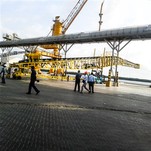
To meet the core operational requirement of enabling container truck drivers to complete equipment docking without exiting their vehicles, our container tilter-featuring fully hydraulic drive and intelligent alignment technologies-plays an indispensable role in grain storage facilities, ports and terminals, freight yards, and large-scale industrial enterprises.
Our container tipper features a base equipped with a horizontal movement mechanism; the opening and closing of the arms are independently controlled by hydraulic cylinders on both sides, allowing for stepless adjustment of the opening width.
The container tilter's operational workflow is as follows:
Open-Access Entry: Before the vehicle enters, the arms on both sides fully retract to create a wide entrance, allowing the driver to drive straight in without the need for repeated maneuvering.
Adaptive Clamping: Once the vehicle is stationary, the arms move inward to clamp the container securely yet gently, adjusting their position based on the container's actual placement.
Precision Tilting: After clamping, the container tilter's main tilting hydraulic cylinder tilts the container 90° into an upright position. Simultaneously, telescopic lateral hydraulic cylinders mounted on the container tilter's tipping frame make fine adjustments to precisely align the container's discharge opening with the ground-level discharge chute or reach stacker, ensuring zero material spillage.
This continuous "drive-in, clamp, tilt, and align" workflow reduces the loading and unloading time per vehicle to just a few minutes, significantly boosting transshipment efficiency.

Fully Hydraulic Drive System and Dual Control Modes
An electric motor powers the container tilter. Compared to diesel-powered alternatives, it offers environmentally friendly advantages such as low noise and low vibration, making it particularly suitable for indoor warehouses or freight terminals located near residential areas with strict noise regulations.
Regarding control, the container tilter offers flexible configuration options:
Standard Configuration: A fully hydraulic multi-way valve control system that ensures responsive, smooth operation.
Premium Configuration (Optional): Wireless remote control operation with an effective range of up to 150 meters. Operators can step out of the cab to execute all functions-such as tilting and extending-while maintaining an optimal, unobstructed view, thereby eliminating risks associated with blind spots.
Custom Configuration (On-Demand): Manual multi-way valve control, catering to long-time users who prefer traditional operating methods.
Core Hydraulic Components and Heavy-Load Stability Design
The safety of the tilting operation relies on the robust specifications of the hydraulic system. The large-bore design of the pistons in both the lifting and auxiliary hydraulic cylinders offers significant advantages:
Exceptional Lifting Capacity: Capable of easily handling the immense overturning moments generated by fully loaded containers (including those carrying heavy bulk cargo such as scrap steel metal or grain).
Smooth Tilting Process: High-flow hydraulic oil combined with counterbalance valves ensures a pulsation-free operation, effectively protecting the container structure from damage.
Additionally, there are specific requirements regarding the installation foundation:
For stationary container tilters, a foundation must be constructed according to the provided drawings to anchor the machine securely to the ground.
Mobile container tilter's installation (Optional): If industrial-grade heavy-duty casters are used for mobile operation, the ground must consist of a thick, hardened reinforced concrete slab. The surface must be level and free of potholes or depressions to prevent the container tilter from tilting over due to ground subsidence during heavy-load operations.

Application Scenarios and Industry Value
This container tilter precisely addresses the logistics trend of shifting bulk cargo from loose transport to containerized shipping. Its core value lies in converting loose bagged or bulk materials into standardized containerized units while enabling efficient, clean, and automated unloading at the destination.
Typical application scenarios include:
Grain Storage Facilities
Used for the rapid unloading and warehousing of imported grains-such as soybeans, corn, and wheat-shipped in containers. After the container tilter tilts the container into a vertical position, the grain flows into an underground receiving pit under its own weight; this effectively resolves the issues of low efficiency and high labor costs associated with traditional manual handling methods.
Port Terminals
Significantly enhances the efficiency of bulk cargo handling at terminals. In the terminal's rear yard, the tipper can rapidly tilt containers arriving by sea to discharge their contents directly into self-unloading trucks. This drastically reduces vessel turnaround times and boosts overall terminal throughput efficiency.
Chemical and Fertilizer Enterprises
Handles moisture-sensitive and dust-prone bulk cargoes such as urea, compound fertilizers, and potassium chloride. By combining a container tipper with a sealed discharge hopper, the system enables fully enclosed unloading; this effectively contains dust emissions, protecting worker health and preventing environmental pollution while minimizing the risk of material clumping due to moisture.
Large-scale Freight Terminals
Serves as a versatile, multi-purpose loading and unloading container tilter capable of flexibly handling the unloading needs of various bulk cargo types. It enhances container tilter utilization and return on investment while reducing costs associated with equipment idleness.
Steel Plants and Scrap Metal Recycling
This container tilter is used to process recycled metals, such as scrap iron, scrap steel, and compacted light-gauge scrap. Steel plants frequently transport scrap raw materials in containers; a container tipper rotates the container to a vertical position, allowing a scrap handler to discharge the contents into a receiving hopper or onto a vibrating feeder.
Extremely high unloading efficiency: A fully loaded 20-foot scrap container far outperforms traditional methods using clamshell grabs or manual sorting.
Enhanced operational safety: Operators do not need to enter the container for cleaning or rigging tasks, keeping them away from high-temperature smelting zones and the risk of injury from sharp scrap edges.
The tipper discharges material solely through the rotation of the container itself; as there is no direct friction between the equipment and the material, maintenance costs are significantly reduced.