

As a core auxiliary tool for container handling operations, the selection of container spreaders must be comprehensively determined based on crane equipment specifications, operating scenarios, container dimensions, usage frequency, and certification requirements. This choice directly affects operational efficiency, safety, and equipment compatibility. So, how should we choose the right container lifting beams?
I. Selection Based on Lifting Equipment Conditions
Single-hook cranes / marine deck cranes
Mechanized semi-automatic spreaders are preferred, as this type of equipment typically lacks a hydraulic or electrical power supply. Pure mechanical spreaders that automatically open and close twistlocks via the hoisting and lowering of wire ropes shall be selected. They require no modification to the crane's electrical system or additional hydraulic power units, enabling true "plug-and-play" operation.

Double-hook / four-hook cranes, quayside container cranes
These are suitable for fully automatic hydraulic or electric spreaders, which shall be equipped with remote control, telescopic drive, real-time twistlock status feedback (LED indication), and anti-sway functions. If the equipment supports an electric control system (PLC), intelligent spreaders capable of data interaction shall be prioritized.
Equipment not suitable for electrical retrofitting
Pure mechanical structure spreaders are recommended. These are independent of external power sources, easy to install, and highly versatile.
II. Selection According to Container Specifications
Single Container Type Operation
Fixed-size spreaders (dedicated for 20ft or 40ft) are recommended. These offer excellent overall structural rigidity with high bending and torsion resistance. They are 15%–20% lighter in dead weight compared to telescopic spreaders, with lower procurement costs and simpler maintenance. They are suitable for railway yards or specific barge operations.
Mixed Operation of Multiple Container Types
Telescopic over-height container spreaders shall be selected, capable of covering three standard lengths: 20ft, 40ft, and 45ft. Key considerations include the synchronization of the telescopic mechanism (to prevent deflection and jamming) and the expandable support capability for twin-lift mode. The twin-lift function shall be optional if two 20ft containers need to be lifted simultaneously.
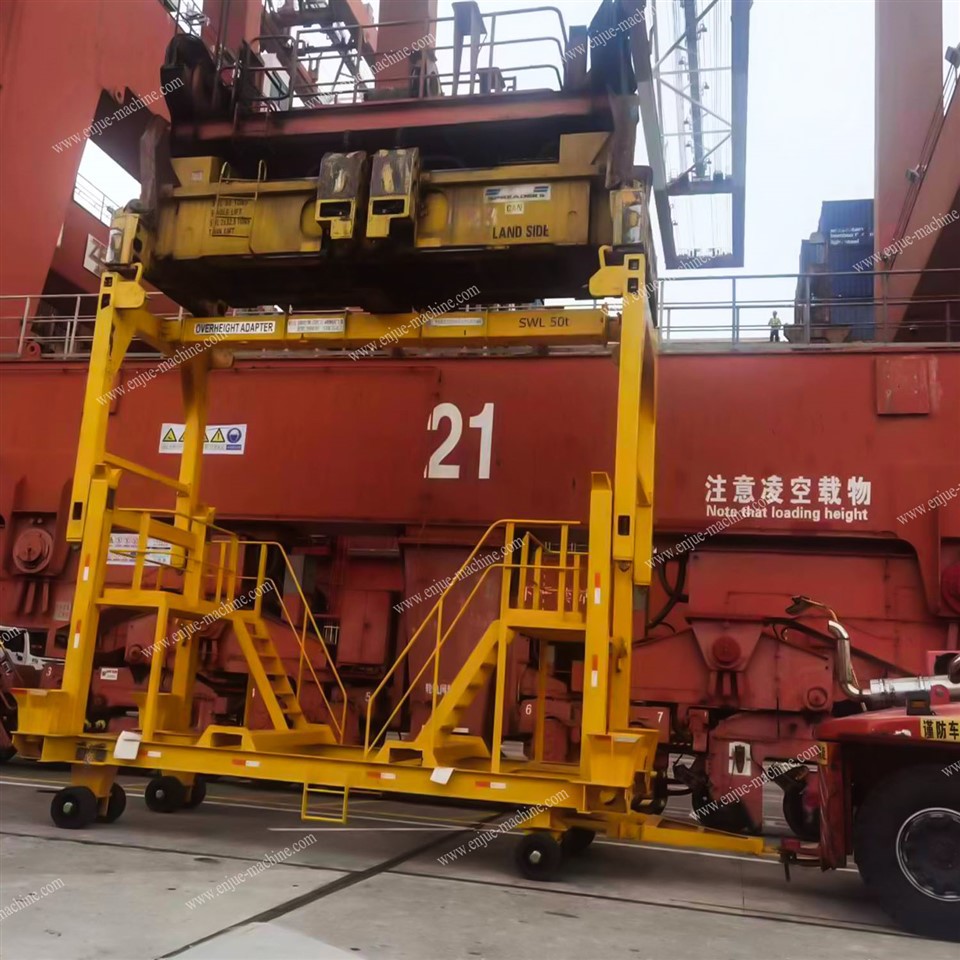
III. Selection by Structural Type
I‑Frame Spreader
Featuring small lifting point spacing, low headroom requirement, and high overall rigidity, the I‑frame spreader is suitable for space‑constrained scenarios such as ship decks and small‑range lifting equipment.
H‑Frame Spreader
With balanced stress distribution, excellent stability, and higher load‑bearing capacity, the H‑frame spreader is suitable for heavy‑duty lifting equipment and large‑span operations at terminals.
Simple Frame Spreader
Simple in structure and low in cost, the simple frame spreader is ideal for temporary loading/unloading and low‑frequency operation scenarios.
IV. Selection by Drive and Control Mode
Mechanical Semi-Automatic Spreader
This type features fully mechanical linkage actuation with no need for electricity or hydraulics. It offers extremely high reliability (IP rating equivalent to mechanical components), but generally lacks telescopic function. It is suitable for retrofitting old equipment, ship-mounted cranes, and low-frequency scenarios with annual throughput below 50,000 TEU.
Hydraulic Telescopic Spreader
This spreader provides powerful drive and fast telescopic action, equipped with an anti-unhooking protection function. However, there is a risk of oil leakage, and preheating is required in winter. It is the mainstream configuration for terminals.

Electric Intelligent Spreader
Telescopic and twistlock actions are driven directly by servo motors, offering millimeter-level control accuracy, fast response, high energy efficiency, and easy integration into automated systems. It is suitable for automated terminals and high-end RTG retrofitting.
In conclusion
The container spreader selection should be based on equipment adaptability, centered on operational requirements, and take into account safety, durability, and cost-effectiveness. For high-frequency operations, fully automatic models are preferred. For simple retrofits or modifications, mechanical models are more suitable. For marine applications, compact and highly rigid structures are the priority.


