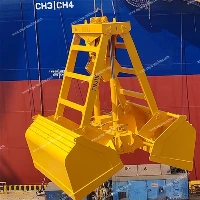
I. Process Basis and Standardization of Our Container Tilter
"According to the ENJUE's container tilter standard welding process," typically refers to strictly following the company's established Welding Procedure Specification (WPS). This specification must be based on national standards (such as GB/T 19867.1) or industry standards and cover the specific requirements of the product. This ensures the standardization and repeatability of the process.
II. Preheating Requirements: Key to Crack Control
For the medium-thick plates of the container tilter, high-strength steels (such as Q345B, Q460), and highly constrained structures commonly used in turning machines, preheating before welding is a core measure to prevent hydrogen-induced cold cracking, improve the microstructure of the heat-affected zone, and reduce welding residual stress.
Temperature Determination: The preheating temperature should be determined based on the material's carbon equivalent (CEV), plate thickness, joint restraint, and ambient temperature. For example, for Q345B steel with a plate thickness of 25mm, the typical preheating temperature range is 100°C to 150°C.
Implementation Method: Flame heating or electric heating is usually used, and the temperature should be maintained uniformly within at least 100mm on both sides of the weld center. The preheating temperature must be verified using a thermometer on the back of the weld or inside the groove.
Interpass Temperature Control: During welding, the interpass temperature must be monitored and maintained, usually not lower than the preheating temperature and not higher than the upper limit (e.g., 250°C), to prevent overheating and embrittlement.
Welding Requirements: Details Determine Quality
Welding process parameters must be clear and executable, typically including:
Welding Method: High-efficiency, low-hydrogen gas-shielded arc welding with argon-rich shielding gas (such as 80% Ar + 20% CO₂) is preferred to ensure penetration depth and toughness; for deep grooves or extra-thick plates, submerged arc welding can be used to improve efficiency and quality stability.
Welding Material Matching: The welding wire/electrode type must match the strength and toughness of the base metal, and the diffusible hydrogen content must be strictly controlled (low-hydrogen type). For example, ER50-6 welding wire or J507 electrodes are commonly used for welding Q345B steel.
Bevel Design and Machining: Design appropriate bevel shapes (such as V-groove, U-groove, or X-groove) based on plate thickness and welding process, and specify machining accuracy (angle, root face, and gap) and cleanliness requirements to ensure proper fusion quality and control deformation and filler metal volume.

Welding Sequence and Deformation Control: Develop a scientific welding sequence (such as symmetrical welding or segmented back-step welding) and utilize appropriate fixtures and jigs to minimize welding deformation and residual stress. For large box-shaped structures, special attention should be paid to the welding direction and layer arrangement.
Evaluation Criteria: Quality Verification Standards: Weld quality must be inspected and classified according to clear standards. For critical welds in slewing mechanisms subjected to alternating loads (such as slewing bearing connection welds and main load-bearing stiffener welds), stricter standards should be applied.
Internal Quality Inspection (Non-Destructive Testing - NDT):
Ultrasonic Testing (UT): According to GB/T 11345 standard, applicable to most full penetration welds, with high sensitivity to area-type defects (such as cracks and lack of fusion). Critical welds usually require Level B inspection, with a quality level no lower than Level I.
Appearance and Dimensional Quality: The container tilter weld appearance quality shall be assessed according to GB/T 19418. Defects such as cracks, incomplete fusion, root shrinkage, and excessive undercut are not permitted.
Weld dimensions (such as leg height and reinforcement) must conform to the drawing requirements, and a smooth transition between the weld and the base metal must be maintained.

Additional Testing: For particularly critical structures, weld hardness testing, macroscopic metallographic examination, or welding procedure qualification tests may also be required to comprehensively verify their performance.
Post-Weld Treatment (if applicable)
Hydrogen Removal Treatment: For thick plates of high-strength steel welds, the weld should be immediately held at a temperature of 250°C to 350°C after welding to accelerate hydrogen diffusion and prevent delayed cracking.
Stress Relief Annealing (PWHT): For structures with extremely large thickness or high restraint, overall or local annealing may be required to stabilize dimensions and improve stress corrosion resistance.
Deformation Correction: Correction of excessive deformation is permitted under controlled conditions using mechanical methods or local heating.