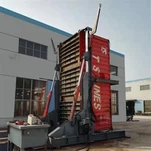
Types and Selection of Weighing Sensors of the Container Tilter
1. Strain Gauge Sensors
Principle: When a metal elastic body is subjected to a force, it deforms, and the resistance value of the strain gauge attached to it changes. This change is converted into an electrical signal through a Wheatstone bridge.
Advantages:
High accuracy (up to 0.02%~0.05% FS)
Good long-term stability
Suitable for static and quasi-dynamic weighing
Disadvantages:
Sensitive to shock and vibration
Requires protection against water and dust
Applicable scenarios: Static weighing of turning machine legs or platforms, batch weighing.
2. Piezoelectric Sensor
Principle: Utilizes the phenomenon of piezoelectric materials generating an electrical charge signal when subjected to force.
Advantages:
Fast response speed, suitable for dynamic measurements
Impact-resistant and high-temperature resistant
Disadvantages:
Not suitable for long-term static measurements (charge leakage is likely)
High temperature sensitivity
Applicable scenarios: Real-time monitoring in situations involving high-speed rotation and significant vibration.
Installation Location and Structural Integration

3. Installation below the platform
Method: The sensor is placed between the rotating platform and the base.
Advantages:
Direct measurement of total load
Compact structure
Precautions:
Requires protection against lateral forces and torque
High platform rigidity is required to prevent deformation from affecting accuracy
4. Installation at the Support Legs
Method: One sensor is installed on each support leg, with multiple sensors connected in parallel.
Advantages:
Distributed measurement, allowing for monitoring of load eccentricity
Easy maintenance and replacement
Precautions:
Each sensor needs to be calibrated for balance.
Wiring and signal merging require protection against interference.
5. Accuracy and Calibration Standards of the container tilter's weighing system
1. International Standards: OIML R60 & R76
OIML R60: Metrological requirements for weighing sensors, classified into grades:
C3 grade (high-precision industrial)
C4 grade (trade settlement)
OIML R76: Standard for non-automatic weighing instruments, applicable to static weighing systems.
2. North American Standard: NTEP
National Type Evaluation Program (USA), applicable to commercial trade weighing equipment.
Certification requires laboratory testing and field evaluation.
3. Calibration Process
Static calibration: Using standard weights, performed by segmented loading and unloading.
Dynamic calibration: Simulating actual working conditions, using test blocks of known mass.
On-site calibration: Regularly verified using portable calibration devices.
6. Instrument Functions and System Integration
1. Core Functions of the container tilter's weighing system
Tare: Automatically deducts the weight of the container or fixture.
Total: Accumulates multiple batches, supports manual/automatic accumulation.
Sorting and Alarm: Sets upper and lower limits; triggers an alarm or shuts down in case of overload.
Unit Switching: kg, lb, t, etc.
2. Data Output and Printing
Interface Types:
RS232/485
Ethernet
USB
4-20mA / 0-10V Analog Output
Printing Function: Built-in or external printer, outputs weight labels or reports.
3. Communication and Integration
Protocol Support:
Modbus RTU/TCP
Profibus
CANopen
Host System Integration: Connects with PLC, SCADA, and MES systems for data traceability and process control.