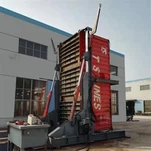
The capacity of a yacht crane varies significantly depending on its design, intended use, and structural features, with common ranges spanning from 1,000 pounds (0.5 tons) to 500 tons.
Lightweight Aluminum Cranes (1,000–1,750 lbs / 0.5–0.8 tons)
Design: Compact, portable cranes are often used on smaller yachts or for recreational purposes.
Features: Standard two-function operation (luffing and lifting), with optional wireless upgrades.
Use Case: Ideal for lifting personal watercraft, dinghies, or light equipment on medium-sized vessels.

Mid-Range Hydraulic Cranes (15–150 tons)
Example: The 15-150t MBH boat hoist features a U-shaped structure for lifting boats above its top beam.
Tonnage: Up to 150 tons.
Structure: U-shaped frame to accommodate tall vessels.
Operation: Remote-controlled with adjustable lifting and running speeds of yacht crane
Use Case: Common in marinas and shipyards for moving yachts during maintenance or storage.

Heavy-Duty Marine Travel Lifts (100–500 tons)
Example: A 300-ton marine travel lift is designed for large yachts and commercial vessels.
Tonnage: Up to 500tons in some models.
Features:
Ground pressure as low as 6.5 kg/m² for stability on soft surfaces.
Variable lifting speeds (0–2 m/min under full load, 0–5 m/min empty).
Traveling speeds up to 35 m/min when unloaded.
Use Case: Essential for dry-docking, repairs, and launching/retrieving large yachts.
Key Factors Influencing Capacity
Structural Design: U-shaped frames allow lifting boats taller than the crane's height.
Material: Heavy-duty steel or aluminum construction for durability.
Mobility: Some cranes are mobile (e.g., travel lifts), while others are fixed.
Application: Recreational vs. commercial use dictates size and power requirements.