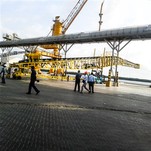
A Telescopic Ship Loader Conveyor (often just called a Telescopic Ship Loader) is a specialized, high-capacity machine used to load bulk solid materials (like grain, coal, iron ore, fertilizers, etc.) into the holds of cargo ships.
Its key feature is its telescoping, which allows it to extend and retract, much like a telescopic lens on a camera.
The Loading Process in Action
The ship docks alongside the loader.
The shore-based conveyor system feeds material (e.g., wheat) onto the loader's belt.
The operator moves the loader to the first hatch.
Using the slewing, luffing, and telescoping functions, the operator extends the boom and positions the discharge point directly over the center of the hold.
As the hold fills up, the operator can retract the boom slightly and use the slewing function to distribute the material evenly, preventing the pile from becoming too steep (which can damage the ship's structure).
Once one hold is full, the operator retracts the boom, moves the loader to the next hatch, and repeats the process.
Comparison to Non-Telescopic Loaders
Before telescopic ship loaders, ports often used fixed-length boom loaders or simpler chutes. These were less efficient because to change the loading position, the entire machine had to be moved, or the ship itself had to be shifted. Telescopic loaders offer far greater operational flexibility and speed.