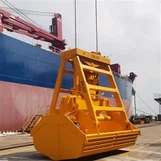
Shanghai ENJUE Machinery Equipment Co., Ltd is one of the most experienced manufacturers and suppliers of fixed container spreader in China. If you're going to buy custom fixed container spreader made in China, welcome to get more information from our factory. For price consultation, contact us.
The fixed container spreader is a convenient lifting tool designed for efficient loading and unloading of various container types. As a critical component in the container logistics handling chain, the spreader directly influences the efficiency, safety, and stability of container operations. It has become an indispensable core supporting product for modern smart ports and standardized logistics transportation systems.
Main Functions
The fixed container spreader performs three core functions in port handing containers.
1. Universal Standard Compatibility
Fits 20GP, 40GP, 40HQ, 45HQ – all mainstream container types. No manual steel wire rope binding needed. Compatible with internationally standardized sizes – ready for sea, land, and air logistics.
2. Comprehensive Safety Protection
Four‑corner twist locks fasten securely onto container corner castings during lifting. No sliding. No tilting. No falling. Eliminates the hidden dangers of traditional slings – uneven force distribution, wire rope breakage – and drastically cuts on‑site accidents.
3. High‑Efficiency Operation
One‑touch lock. One‑touch unlock. Fully automated mechanical operation. Less time on positioning, securing, and detachment – more productivity for high‑frequency, high‑volume port handling.


Type of Container Spreaders and Application
1. Fixed Container Spreader (Manual Spreader)
The fixed spreader features an integral rigid frame with non‑adjustable dimensions, designed for a single container size – most commonly 20ft or 40ft. It offers a simple structure, extremely low failure rate, and low cost, requiring no electric power supply. Locking and unlocking are performed manually.
Applications: Low‑throughput yards, inland depots, short‑distance terminals – single‑standard container handling.
2. Telescopic Container Spreader (Electric Spreader)
This is the mainstream universal model widely adopted in ports today. Driven by an electro‑hydraulic telescopic mechanism, it automatically switches between 20ft, 40ft, and 45ft containers without manual spreader replacement. Equipped with hydraulic systems, electric control systems, telescopic assemblies, and safety detection devices, it delivers high automation, accurate positioning, and rapid size conversion.
Applications: Port terminals, large container yards, freight hubs – high‑frequency mixed container sizes. Works with ship‑to‑shore cranes, RMG, and RTG.
3. Compact Rotating Spreader (Forklift Special Spreader)
Custom‑engineered for container forklifts, this spreader features a compact body and easy installation, with 360° rotational positioning for confined working spaces. Available in manual and semi‑automatic types, it is easy to operate and highly maneuverable – compensating for the limited flexibility of larger spreaders.
Applications: Small inland yards, factory container transfer, warehouse loading/unloading – space‑constrained sites.
4. Twin‑Lift Spreader
A high‑end equipment option for major ports, capable of lifting two 20ft standard containers simultaneously. It supports single‑container independent hoisting and synchronized twin‑container hoisting, serving as core equipment to boost port throughput. Designed with high structural strength, precise control systems, and separate lock detection functions for twin‑container safety.
Applications: Major hub ports, automated terminals, high‑throughput yards – mass cargo handling at scale.
Core Components and Working Principle

Sling/ Sling Ring
Quality assurances.
China classification society certification.
Using to connect slings and crane hooks.
Twist Lock
Using to connect containers and control their opening and closing.


Lifting Gear Switch Indicator
Using to indicate direction and to identify open and closed status.
Triangle Gravity Block Buckle
Useing together with the middle control lever to open and close the cable rope.


Why choose the fixed container spreader ?
Excellent Safety Performance
Dual protection – full mechanical locking and electrical detection – completely eliminates risks of container falling, tilting, and slipping. Fully compliant with port lifting safety codes, it is suitable for heavy‑duty industrial working conditions.
Operational Efficiency
It eliminates the tedious procedures of binding and untying steel wire ropes required by traditional methods. Electric models can rapidly switch container sizes and lock containers automatically, boosting work efficiency by 3 to 5 times and catering to large‑scale logistics operations.
Versatility
Fully compatible with ISO international standard containers, it can be matched with various lifting equipment – including ship‑to‑shore cranes, gantry cranes, container forklifts, and truck cranes. It covers all working scenarios such as sea‑land intermodal transport, yard circulation, and factory on‑site transfer.
Durability
The entire spreader is fabricated from high‑strength wear‑resistant materials. All key components undergo quenching and tempering treatment to deliver outstanding fatigue resistance, impact resistance, and corrosion resistance. It can withstand long‑term harsh outdoor environments with heavy loads and high salt fog, featuring a long service life and low maintenance costs.
Support for Intelligent Upgrade
New intelligent spreaders can connect to port automation systems, equipped with data monitoring, fault alarm, and operation statistics functions – well adapted to the unmanned operation trend of smart ports.


How to choose the right container spreader?
Do not blindly over‑spec or under‑spec spreaders. Selection shall be based on operation site, container size, crane parameters, working frequency, and service environment to balance safety, practicability, and cost performance. Five key selection criteria are as follows:
1. Select by Operation Site and Working Frequency
Small inland yards, factory low‑frequency transfer, single container type: Fixed manual spreader – simple structure, low failure rate, cost‑effective.
Seaports, large freight hubs, mixed container sizes and high throughput: Electric telescopic spreader – automatic size switch for heavy continuous work.
Automated large hub ports, mass handling: Twin‑lift spreader – lifts two 20ft containers at once for higher productivity, compatible with smart unmanned terminals.
Confined space, matched with forklifts: Special rotating forklift spreader – compact, 360° rotation for flexible positioning.
2. Select by Regular Container Dimensions
Only 20ft containers: 20ft fixed spreader.
Mainly 40GP/40HQ: 40ft fixed or telescopic spreader.
Alternating 20/40/45ft containers: Multi‑function telescopic spreader covering 20‑40‑45ft.
Dimensions must match ISO standard containers to ensure tight fit between twist locks and corner castings.
3. Select by Rated Load and Lifting Equipment Parameters
Basic rule: Rated load of spreader ≥ maximum full load weight of containers.
Full 20ft container: 32‑ton spreader.
Full 40/45ft container: 40‑ton spreader.
Simultaneous twin‑lift operation: 64‑ton twin‑lift spreader.
Match lifting height, suspension size, and interface specifications of gantry cranes, STS cranes, and forklifts for stable assembly and coordination.
4. Select by Working Environment
Coastal ports and seaside yards (outdoor, high salt fog and humidity): Anti‑corrosion enhanced spreaders with full rust‑proof coating, high IP‑rated hydraulic and electrical parts to resist salt corrosion and weather aging.
Dry inland factories and indoor warehouses: Standard spreaders to cut procurement cost.
Low‑temperature and dusty sites: Dustproof and anti‑freeze reinforced spreaders to prevent jamming and breakdown.
5. Select by Automation Demand and Maintenance Cost
Manual operation and limited budget: Manual fixed spreader with minimal maintenance cost.
Long‑term mass operation for labor saving: Electro‑hydraulic telescopic spreader for semi‑automated workflow.
Unmanned smart ports and automated yards: Intelligent spreaders with PLC control, data monitoring, and fault alarm – connectable to terminal automation systems.
Tip: Choose mainstream models with universal spare parts and convenient after‑sales service to lower repair cost and equipment downtime.
Daily Maintenance and Operation Precautions
Pre‑shift Inspection
Before daily operation, check that the four‑corner twist locks rotate smoothly and engage fully. Inspect the main frame for deformation and welds for cracks. Verify that the electrical and hydraulic systems are free from oil leakage and wiring faults.
Periodic Maintenance
Regularly apply lubricant to twist locks, pin shafts, and telescopic guide rails to prevent jamming and excessive wear. Routinely wipe off dust and salt spray contaminants from the spreader surface, and perform anti‑rust and anti‑corrosion treatment as needed.
Standardized Operation
Overload lifting and diagonal pulling are strictly prohibited. Never lift containers before all twist locks are fully locked – doing so may deform the equipment under abnormal stress and lead to safety accidents.
Troubleshooting and Repair
Stop operation immediately for inspection if locking failure, telescopic jamming, or system alarms occur. Do not operate faulty equipment. Arrange for professional technicians to calibrate and maintain the hydraulic and electrical control systems on a regular basis.
Packing and Transportation
Container spreaders are transported by truck in a stacked arrangement, then loaded vertically into shipping containers. This loading solution delivers high space utilization and easy handling for loading and unloading, with a maximum capacity of four spreaders per shipping container.


If you are looking for premium container spreaders that combine outstanding performance, long service durability, and comprehensive safety protection, your search ends here. Our high‑end container spreaders are fully compatible with lifting operations across various ports and yards, meeting all your operational requirements. Please feel free to contact us for inquiries and orders, and experience the reliable, efficient performance of our products firsthand.
Hot Tags: fixed container spreader, China fixed container spreader manufacturers, suppliers, factory, cargo handling machinery, cargo hoisting equipment, cargo stacking equipment, cargo storage equipment, loading equipment for cargo, unloading equipment for cargo