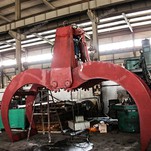
As core equipment for bulk cargo handling, the selection of container tilters directly impacts operational efficiency and costs. Mainstream products on the market fall into two categories-fixed hydraulic container tilters and mobile container tilters-which differ significantly in terms of application scenarios and technical characteristics.
I. Fixed Type Container Tilter: A Stable and Efficient "Heavy-Duty Workstation"
The fixed-type hydraulic container tilter is one of the most mature and widely used pieces of equipment in bulk cargo handling. Its defining characteristic is the lack of self-propulsion; the entire unit is permanently installed-via anchor bolts or embedded components-onto a specially designed concrete foundation, creating a fixed operational station once in place. This "anchored" configuration dictates an operational profile characterized by precise positioning, accurate movements, and high repeatability, making it particularly suitable for large-scale operations with standardized workflows and clearly defined site zoning.
Structural Stability and Load-Bearing Capacity
Eliminating the need for travel mechanisms, steering systems, and associated suspension components allows stationary container tilters to feature a more robust and rigid overall structure, offering inherent advantages in resistance to overturning moments and fatigue. The container tilter's main structure typically utilizes welded box-girder sections made of high-strength, low-alloy steel, with critical pivot points optimized via finite element analysis to withstand the cyclic loads associated with large-angle tilting over the long term. The core hydraulic system of the container tilter generally incorporates high-displacement piston pumps and accumulator banks, enabling multi-stage speed control and smooth start-stop operations; this ensures that the tilting and resetting actions-whether for loading or unloading 20-foot or 40-foot ISO standard containers-are performed both rapidly and gently.

Certain dual-lane container tilters even support simultaneous operations with two containers, boasting a rated lifting capacity exceeding 40 tons per unit, thereby fully meeting the demands of continuous, high-intensity operations in high-throughput environments such as port terminals and railway freight yards.
Fixed-type hydraulic fixed type container tilter based on the comprehensive optimization of the center-of-gravity trajectory, the hydraulic cylinder thrust curve, and the machine's overall tipping safety factor. The selected angle ensures the complete discharge of bulk materials (such as grain, ore, or chemical granules) from the container while preventing issues caused by excessive tilt-namely, localized overloading of the container structure or lateral loading on the hydraulic cylinder piston rod that exceeds permissible limits-thereby achieving an optimal balance between operational efficiency and structural safety.

Applicable Scenarios
Fixed-type container tilters are particularly well-suited for operations characterized by fixed locations, standardized container specifications, and consistently high annual throughput. Typical applications include raw material handling facilities at large manufacturing enterprises, specialized bulk cargo terminals, railway container freight stations, dedicated container stripping and stuffing warehouses within bonded logistics parks, and industrial sites requiring frequent tipping and unloading, such as grain reserves and cement grinding plants.
Installation and Supporting Requirements
Installing stationary equipment involves complex civil engineering work, with prerequisites far more demanding than those for mobile units. First, a specialized reinforced concrete foundation must be constructed based on the equipment's load profile and local geological conditions; specifications regarding foundation depth, reinforcement ratio, concrete grade, and the positioning accuracy of embedded parts must strictly adhere to the design drawings. Second, site planning must account for the container tilter's physical footprint, the maximum turning radius of the tipping arm, and access lanes and turning space for container transport vehicles.
It is also essential to consider the swing envelope of the container's rear section during operation to ensure adequate safety clearances from surrounding structures, utility lines, and fire safety facilities. If the existing power supply is insufficient, additional capacity upgrades or a diesel backup power unit will be required; as this significantly increases the initial investment cost, it must be factored into the equipment selection process.
II. Mobile Container Tilter: A Versatile, Agile Performer
The most distinctive feature of the movable container tilter is its integrated wheeled chassis. This design allows for both short-distance repositioning within a single yard and rapid long-distance transfer between facilities using flatbed trailers or low-boy semi-trailers. By serving multiple dispersed work sites with a single, multi-purpose unit, it significantly reduces the need for users to invest in multiple pieces of stationary equipment.
Mobility and Site Adaptability
Equipped with an integrated or articulated mobile chassis and solid tires, this model offers exceptional adaptability. Certain high-end versions feature self-propulsion capabilities, enabling on-the-spot turning, lateral movement, and orientation adjustments at any angle within factory aisles-thereby drastically reducing reliance on auxiliary equipment such as tow trucks or pallet jacks. Its flexibility-characterized by "operate upon positioning and depart upon completion"-makes the mobile container tilter particularly advantageous. Users can flexibly schedule the mobile container tilter based on daily container volumes and rotate operations across multiple workstations, effectively maximizing equipment utilization.

Power and Control Systems
To accommodate varying power supply conditions at different factory sites, the mobile container tilter typically offers a dual-power mode option. It features a 37 kW motor with an IP55 protection rating (dust-tight and protected against water jets), ensuring stable operation within an ambient temperature range of -10°C to +40°C and meeting safety requirements for operation in wind speeds of up to 25 m/s (approximately Force 10 on the Beaufort scale). Regarding control, the movable container tilter comes standard with both a handheld joystick and a wireless remote control system. Operators can remain at a safe distance from the tilting zone while executing the full sequence of operations-such as tilting for loading or unloading and resetting-from an optimal vantage point; this setup not only enhances operational convenience but also significantly improves personnel safety margins.
Functional Integration and Operational Efficiency
The core value proposition of mobile container tilter lies in packing multiple functions into a compact footprint. Advanced self-propelled mobile container tilters utilize modular design to integrate a suite of capabilities-including autonomous mobility and precision positioning, automatic container gripping and locking, multi-angle tilting for discharge, remote container door operation, and dynamic weighing with off-center load monitoring. The weighing system function is typically achieved by embedding high-precision strain-gauge sensors within the hinge pins of the lifting arm or tilting frame; these sensors capture real-time load data from various support points during the tilting process. This data is processed via algorithms and displayed digitally in the operator's cab or on a remote control terminal. Should the off-center load ratio or total weight exceed safety thresholds, the system triggers an audible and visual alarm and automatically halts the tilting operation, thereby preventing equipment tip-over accidents caused by overloading or unbalanced loads at the source.
Selection Recommendations
For operations at fixed locations involving high throughput and standardized container specifications, stationary equipment-thanks to its structural stability and load-bearing capacity-offers superior reliability and safety for long-term, high-intensity use.
For scenarios involving variable work sites, frequent relocation, or site constraints, a mobile tilter is the ideal choice. Features such as integrated tires, wireless remote control, and rapid tilting capabilities significantly reduce reliance on auxiliary equipment and enhance scheduling efficiency across multiple sites.