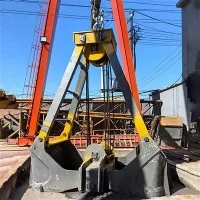
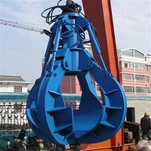
This container tilter's system aims to achieve efficient integration and seamless connection of three major functions: container tilting, loading/unloading, and dynamic weighing. Its core workflow is designed as follows:
Positioning and Clamping: The mobile chassis transports the system to the container's designated location, where adaptive clamps on the tilting mechanism precisely position and securely lock the container.
Tilting and Loading/Unloading Operations: Under the command of the control system, the tilting mechanism (usually driven by high-torque hydraulics) smoothly lifts the container and tilts it at a predetermined angle from 0° to 90° or 180° to facilitate the unloading of bulk materials or the reversal of cargo.
Integrated Weighing: During the lifting or hovering phase of loading and unloading operations, high-precision weighing sensors integrated into the support points of the tilting mechanism or the lifting chain collect load data in real time. The container tilter's system automatically deducts the tare weight and calculates and displays the net weight of the cargo inside the container in real time.
Data Linkage and Reset: Weighing data is synchronously uploaded to the management system. After completion, the system resets and moves to the next work point. The entire process is seamless, achieving synchronization of logistics and information flow.
, calculates, and displays the cargo's net weight
Overall Layout and Modular Architecture
The system adopts a modular integrated design to enhance reliability, facilitate maintenance, and facilitate functional expansion. The overall layout is based on a heavy-duty mobile chassis, with core functional modules integrated on top:

Container Tilter Mechanism Module: As the core execution unit, it typically consists of a high-strength steel tilting arm, a large-displacement hydraulic cylinder, a hydraulic pump station, and an adaptive rotary lock. The design must focus on torque output curves, lifting smoothness, and structural fatigue resistance.
Mobile Chassis and Walking Mechanism: Serving as the foundation for system mobility, a heavy-duty industrial vehicle chassis is used, equipped with high-load-bearing solid tires or off-road tires. This includes a drive axle, steering axle, rigid frame, and suspension system, ensuring smooth movement and parking operations on complex terrains such as docks and warehouses.
Control System and Sensor Layout: Control Core: An industrial PLC (Programmable Logic Controller) is used as the main control unit, responsible for coordinating hydraulic, weighing, and walking logic.
Detailed Design of Mobility
Steering Mechanism: Depending on mobility requirements, hydraulic power-assisted front-wheel steering or a more flexible all-wheel steering/crawl mode can be adopted to achieve precise positioning in confined spaces.
Power System: Typically equipped with a high-power diesel engine or an electro-hydraulic hybrid system, providing ample and stable power to the hydraulic pump station and drive system, adapting to field conditions without an external power supply.
Braking System: Employing a multi-circuit hydraulic braking system of the mobile container tilter, featuring service brake, parking brake, and emergency braking functions, ensuring absolute safety during movement and operation. Braking performance must meet the requirements for parking on slopes.