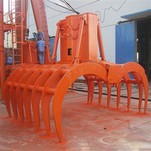
A double-lane container tilter is a specialized mechanical device that utilizes synchronized moving mechanisms (typically referred to as "carriages" or "slides") on two parallel tracks to clamp and precisely rotate large workpieces (such as steel plates, molds, beams, fuselages, and blades) by 180° in space.
Working principle: The workpiece is fixed between two synchronously operating flipping carriages.
An electrical or hydraulic drive system controls the two carriages to move towards or away from each other at the same speed along the tracks, simultaneously driving the workpiece to rotate around its horizontal axis. The core principle is the coordinated control of the synchronous movement of the dual tracks and the rotational movement of the flipping axis.

Rail System of the double lane container tilters:
Base Rails: Fixed and installed on the ground or foundation, requiring extremely high levels of horizontality and straightness. Typically uses heavy-duty steel rails or custom-welded rails.
Mobile Trolley/Slide: Mounted on the rails, supporting the tilting mechanism. It has drive wheels and idler wheels at the bottom, driven by a motor.
Tilting and Clamping Mechanism:
Fixed End: One side of the trolley is usually equipped with an active tilting power unit (such as a hydraulic motor or a high-torque geared motor).
Floating End/Synchronous End: The other side of the trolley is equipped with a passive synchronization mechanism, which may include a torque synchronization device or a structure that allows for a certain degree of axial float to accommodate minor variations in workpiece length or installation errors.
Drive and Transmission System of the double lane container tilter:
Traveling Drive: The two trolleys typically use a "master-slave" or "fully synchronized master-slave" control system. Common configurations include a motor, gearbox, and rack and pinion, or a motor, gearbox, and direct wheel drive. For high-precision applications, servo systems or encoder-based closed-loop control are used to ensure synchronization.
Rotation Drive: This drives the workpiece rotation and typically uses a low-speed, high-torque hydraulic motor or an explosion-proof motor with a brake + a high-ratio gearbox.