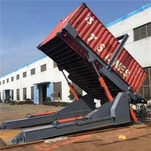
A fully loaded 20-foot container tilter can weigh up to 30 tons; when it is lifted and tilted to angles of 45°, 60°, or even 90°, any synchronization error exceeding 5 mm in the displacement of the lifting cylinders on either side could cause the container to slide off the tilting platform or the equipment to tip over.
Why is synchronization control needed? - The challenge of asymmetric loads
When the container is being tilted, the cargo may shift to one side (for example, due to unevenly piled bulk cargo), causing the loads borne by the hydraulic cylinders on either side to differ significantly:
|
Operating Condition |
Left cylinder load |
Right cylinder load | Results without synchronization control |
|---|---|---|---|
|
Load Shifted to the Right |
10T | 25T | The right-side hydraulic cylinder descends slowly due to the heavy load, while the left descends quickly, causing the tilting frame to twist. |
|
Normal Tilting |
18T | 18T | Ideally balanced, with virtually no deviation. |
|
Emergency Stop |
Dynamic impact |
Dynamic impact | Inconsistent stopping times on the two sides cause swaying. |
Without synchronized control, the lightly loaded side moves before the heavily loaded side, generating a torsional moment on the tilting frame. In extreme cases, this moment is transmitted through the container corner castings to the twistlocks, potentially causing the locking heads to fracture or the container to slide sideways.
Mainstream designs for 20-foot container tilters are transitioning from flow-dividing/combining valves (open-loop) to proportional closed-loop control. Key drivers for this shift include:
Enhanced safety standards: ISO 20430 (2023 edition) mandates that container-tilting equipment must feature real-time off-center load monitoring and automatic load balancing.
IoT connectivity: Closed-loop systems of the container tilter can record cylinder displacement curves for each tilting operation, enabling predictive maintenance.
Operational convenience: One-touch automatic tilting and return, eliminating the need for manual intervention.
The 20-foot container tilter may appear to be nothing more than a framework rotated by hydraulic cylinders. Still, its core technology-synchronous control-directly determines whether the equipment can safely and stably handle 30-ton containers with unbalanced loads.