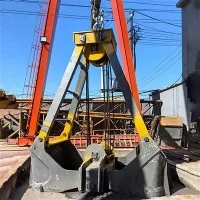
The ENJUE RRCG single-rope remote control grab is a high-performance lifting tool designed specifically for the handling of bulk cargo, making it widely applicable in ports, terminals, and various material transfer operations. It utilizes an innovative mechanism combining single-rope operation with a hydraulic locking linkage, ensuring high operational efficiency while maintaining safety and system reliability. Its structural design integrates mechanical engineering, hydraulic transmission, and wireless remote control technologies, enabling stable performance under harsh operating conditions.
The key features of the single-rope grab are detailed below:
I. Main Structural Composition and Functional Division
The ENJUE RRCG-type single-rope grab is a sophisticated assembly of eleven interdependent primary units, each engineered with precision to fulfill specific mechanical and operational roles. The following sections provide a detailed breakdown of each component, its design rationale, and its contribution to the overall system performance.
Suspension Device
The suspension device serves as the critical interface between the single-rope grab and the crane, integrating the load paths of two closing ropes and one hoisting rope into a unified force transmission system. The grab is easily attached to the crane hook via the provided oval suspension eye. It is imperative to emphasize that, for operational safety, the crane hook must be equipped with a positive-locking safety latch or securing device to prevent accidental disengagement during lifting cycles-a fundamental prerequisite for safe material handling operations.
Grab Head
Situated at the top of the assembly, the single-rope grab head functions as the primary load-bearing structural node. Internally, it houses the upper roller block of the hoisting system, which is arranged in a three-fold reeving configuration. This reeving design optimally balances mechanical advantage and rope travel, enhancing both lifting efficiency and closure force. At the rope exit points, screw-threaded rope bells made of hardened steel are fitted as precision guides for the closing ropes. These hardened guides significantly reduce abrasive wear on the steel ropes, thereby extending their service life and minimizing maintenance frequency.
Pressure Rods
The pressure rods establish a rigid mechanical link between the radio remote control grab head and the two scoops. Acting as the fixed counter-bearing for the closing rope guidance system, these rods ensure that the rope trajectories remain precisely defined under both tension and slack conditions. Their structural rigidity is essential for maintaining alignment of the entire closure mechanism, preventing undesirable deflection that could compromise operational stability.
Mobile Traverse
The mobile traverse incorporates the lower roller block of the hoisting block system, which works in tandem with the upper block to form a complete pulley arrangement. At its lateral ends, the traverse is securely bolted-using high-strength fasteners-to the piston rods of the locking cylinders. This rigid connection enables the tensile forces generated by the closing ropes to be efficiently transferred into the hydraulic locking mechanism, converting rope pull into mechanical clamping power.
Rope Compensation Frame
The terminating ends of the two closing ropes are anchored to the rope compensation frame, which is pivotally connected to the mobile traverse in a pendulum-like fashion. This configuration provides an automatic self-centering function: should the remote control grab assume an inclined attitude during operation-due to uneven load distribution or off-center lifting-the compensation frame ensures that the resultant rope force remains vertically aligned with the centerline of the mobile traverse. This design effectively mitigates eccentric loading, thereby reducing asymmetric rope wear, preventing jamming, and prolonging the service life of both ropes and guide components.
Traverse (Fixed Beam)
The fixed traverse serves as the pivotal articulation point for the two scoops. Beyond its mechanical role as a hinge support, it also houses the hydraulic power unit and the electrical control system. This dual-function design makes the traverse the "mechanical and functional hub" of the entire grab structure, centralizing both load-bearing and control functions in a compact, well-protected enclosure.
Locking Cylinders
The locking cylinders are the core actuating elements that link the mobile traverse and the fixed traverse, forming the critical pathway for transmitting closing forces. During the closing phase, the tensile force from the ropes is transmitted sequentially through the cylinders and the fixed traverse to the scoops, generating a powerful clamping action suitable for handling dense bulk materials. During the opening phase, the hydraulic system releases pressure to unlock the cylinders; the piston rods are then passively extended by the combined gravitational weight of the fixed traverse, the scoops, and the contained bulk material. This gravity-assisted opening ensures a smooth, controlled discharge cycle without requiring active hydraulic power, enhancing energy efficiency.
Scoops
The single-rope remote control grab's scoops are the direct material-engaging elements, designed with optimized volume and contour profiles tailored to the specific characteristics of the bulk cargo to be handled. For heavy or abrasive bulk materials, the scoops are equipped with integrated spill plates. These plates function as an overload protection mechanism: when the internal load exceeds a preset threshold, the spill plates automatically open to release excess material, thereby safeguarding both the grab structure and the lifting appliance from potentially damaging overloading conditions.

II. Power and Control Core Systems
Electrical System
The entire electrical system is enclosed within a rugged steel-plate housing, providing robust protection against environmental influences such as rain, dust, and temperature fluctuations. Power is supplied by a high-capacity nickel-cadmium (Ni-Cd) battery pack, which delivers energy to both the radio transmitter and the solenoid valve. Depending on the switching frequency-i.e., the rate of open-close cycles-a single full charge can support continuous grab operation for up to 24 hours, making it well-suited for demanding shift-work scenarios in port and terminal environments.
Hydraulic System
The hydraulic power unit is compactly integrated within the fixed traverse, minimizing external piping and vulnerability to mechanical damage. High-pressure hydraulic hoses connect the locking cylinders to the oil reservoir and the control valve block. A notable safety feature is the built-in emergency redundancy. In the event of a loss of remote-control signal or an electrical system failure, the solenoid valve can be manually actuated via an emergency mechanical override system. This allows the operator to hydraulically release the locking cylinders and open the grab under manual control, ensuring fail-safe operation even in critical situations.
Radio Remote Control System
The radio remote control system comprises a portable transmitter and a vehicle-mounted receiver. The remote control grab's receiver is co-housed with the electrical system within the protective steel enclosure, shielding it from mechanical impact and environmental hazards. The transmitter offers flexible deployment options: it can be worn by the operator using a neck strap for mobile operation, or it can be stationed permanently in the crane cabin for fixed-installation use. Battery life is approximately 24 hours, contingent upon switching frequency; for stationary use, the transmitter can be optionally equipped with an external power adapter. The supplied battery charger is capable of simultaneously recharging both the transmitter and receiver batteries, with a recharging time of approximately 12 to 14 hours. The charger features automatic voltage adaptation, accepting either 110 V or 220 V mains supply without manual selection, simplifying international deployment.

III. Operational Logic and Safety Feature Summary
Closing Cycle:
The crane hoists the closing ropes, and the resulting tension is multiplied through the three-fold pulley block system. This amplified force drives the mobile traverse upward relative to the fixed traverse. Through the rigid mechanical linkage of the locking cylinders and the fixed traverse, this motion translates into a powerful closing torque applied to the scoops, securely enveloping the bulk material.
Opening Cycle:
The solenoid valve is activated to unlock the hydraulic circuit, depressurizing the rod-end (or piston-side) chambers of the locking cylinders. With no hydraulic counter-pressure, the piston rods are forced outward by the combined deadweight of the fixed traverse, the scoops, and the payload. This passive extension of the cylinders allows the scoops to pivot open smoothly, discharging the material in a controlled gravity-fed manner.
Safety Redundancy:
The single-rope remote control grab incorporates a triple-layer safety architecture to ensure reliable operation under adverse conditions:
Mechanical hook latch – prevents accidental sling disengagement.
Hydraulic manual emergency override – enables forced opening upon electrical or signal failure.
Overload-protective spill plates – provide automatic load relief to prevent structural overstressing.
Together, these integrated safety features ensure that the grab remains controllable and secure even in the event of power loss, signal interruption, or unexpected load surges, thereby delivering a high standard of operational reliability in heavy-duty bulk handling applications.