

As the core terminal actuating mechanism of port loading and unloading equipment, the selection of container spreaders directly determines terminal operational efficiency, equipment compatibility, and full-lifecycle operating costs.
| Item | Typical Model No. | Core Functions and Positioning | Application |
|---|---|---|---|
| Separable twin-box spreader | EJ40-FRIIR-00, EJ40-MRHR-00 | It can simultaneously handle two 20-foot containers or one 40/45-foot container, significantly boosting loading and unloading efficiency. | Large-scale container quay cranes (QC) and high-efficiency rail-mounted gantry cranes (RMG)) |
| Rotating spreader | EJ40-MRHS-00, EJ-FRER (40) |
Features rotation and self-aligning capabilities; suitable for complex operating conditions requiring precise alignment. |
Portal cranes, jib cranes, multi-purpose terminals |
| Single-box spreader | EJ40-MLHR-00, EJ45-FRHR-00 |
The most widely used general-purpose lifting device, available in light-duty, standard, and heavy-duty versions (with lifting capacities up to 51 tons). |
Various types of quay cranes, rail-mounted gantry cranes, and rubber-tyred gantry cranes. |
| Electric motor spreader | EJ40-FRER-00, EJ45-FRES-05 |
Fully electric-driven, energy-efficient and eco-friendly, with high control precision and low maintenance costs. |
Modern terminals with high requirements for environmental protection and control precision. |
| Fixed length spreader | EJ20FLN00 | Designed specifically for containers of specific dimensions, featuring a simple structure and low dead weight. | Portal cranes, gantry cranes, in-plant cranes |
|
Empty container handler spreader |
EJ40-RHS | Specifically designed for handling empty containers, it weighs only 3.5 tons and features full sideshift and floating functions. |
Empty container depot, railway freight yard |
|
Various types of lifting beams and spreader beams |
EJ215A2900, EJ247B2600 |
Used for lifting non-standard or general cargo (such as steel products and bulk goods), expanding the versatility of the lifting equipment. |
General cargo terminal, steel plant, power plant |
|
Spreader Bar Trailer / Man Basket |
EJ3A5C3200 |
Used for the rapid relocation and transport of lifting equipment, as well as for personnel performing safe, high-altitude maintenance and inspections. |
Behind the wharf, equipment maintenance area |
| Over-height Container Spreader | OHAIT20, MOHA40 |
Used for loading and unloading over-height cargo or top-opening ISO standard containers. |
Specialized Cargo Logistics, Project Logistics |
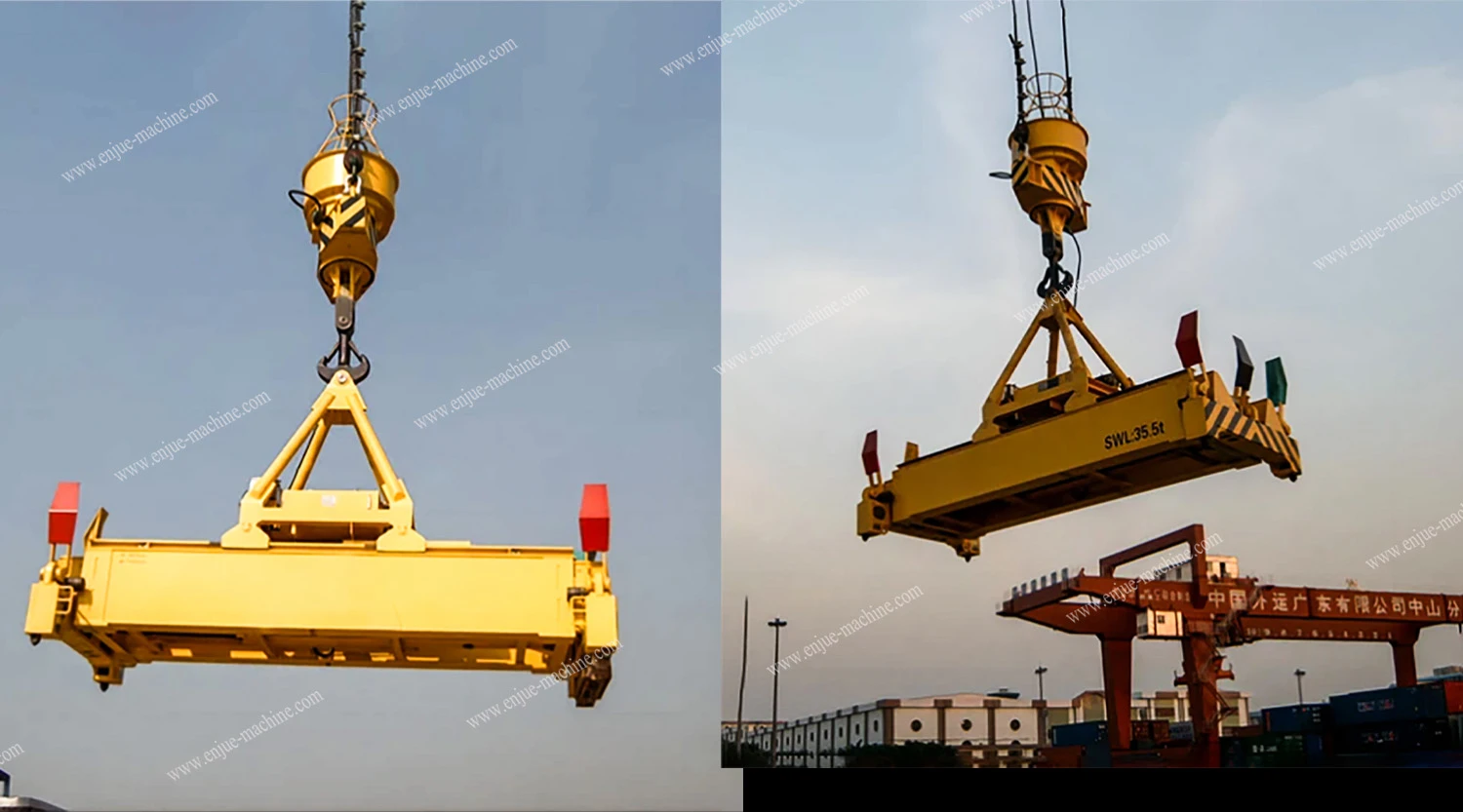


Advanced Selection: Core Performance Indicators-Balancing Efficiency and Reliability
Once general requirements are met, the selection process moves to comparing container spreader dynamic performance parameters. These parameters directly impact the operational efficiency of individual terminal units.
1. Telescopic Mechanism: Determining "Luffing" (Extension/Retraction) Speed
Hydraulic Drive (Mainstream): Uses a hydraulic motor with chain drive; extension/retraction time (20' to 40') typically ranges from 18 to 35 seconds. Offers high power and reliability, making it the preferred choice for heavy-duty operations.
Electric Drive (Emerging Trend): Uses a gear motor; extension/retraction time can be reduced to approximately 22 seconds. Offers smoother operation, lower energy consumption, and reduced maintenance costs, aligning with the trend toward "green ports."
Selection Logic: For high-tempo quay crane operations, prioritize electric or high-performance hydraulic solutions; rail-mounted gantry cranes (RMGs) and rubber-tired gantry cranes (RTGs) have relatively less stringent requirements for extension/retraction speeds.
2. Twistlock Actuation Time: A Factor in "Locking" Success Rates
For all models, the time required for the twistlock to rotate 90° is strictly controlled to under 1 second or 1.5 seconds. Although the difference in this parameter is minimal, it is crucial for the rapid and precise engagement between the container spreader and the container. When selecting a model, consider how the actuation method (hydraulic cylinder vs. electric motor) affects operational stability.
3. Auxiliary Function Modules: Response Speed Equals Efficiency
Guide Arm System: The time required for a movable guide arm to flip 180° is 5–7 seconds. Movable guide container spreader arms are suitable for highly automated ship-to-shore (STS) cranes, whereas fixed (detachable) guide arms feature a simpler design and are suitable for rail-mounted gantry (RMG) cranes and rubber-tyred gantry (RTG) cranes.
Side-shift/Centering Function: Side-shifting by ±300 mm takes approximately 12 seconds, while centering by ±200 mm takes approximately 5 seconds. This function is particularly important for equipment that cannot make fine positional adjustments along a track, such as RTG cranes and portal cranes.
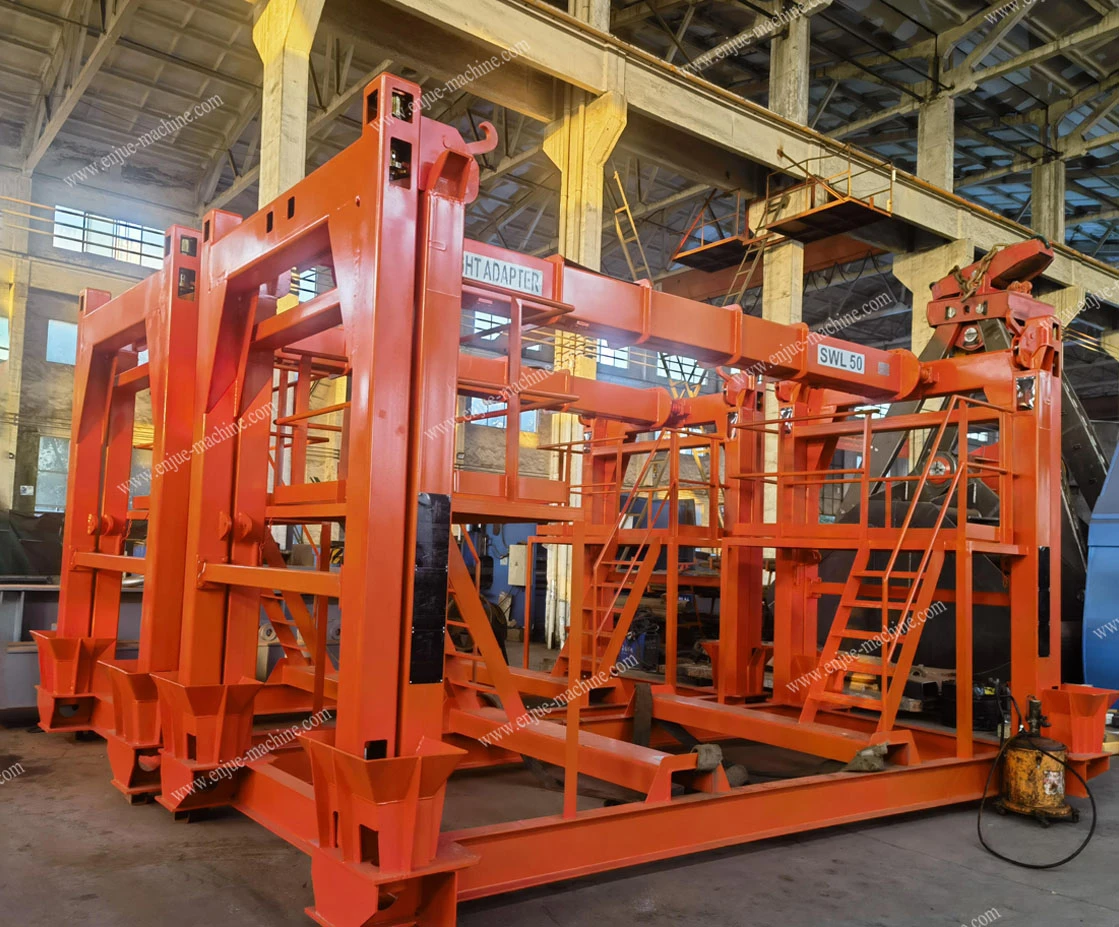
Selection for Special Operating Conditions: "Customized" Considerations Beyond Standard Specifications
For certain operating conditions that fall outside standard or conventional scenarios, the following "implicit" selection factors require special attention:
Corrosion Protection and Coating Systems: The specifications explicitly mandate a coating process comprising two layers of zinc-rich epoxy primer, one intermediate coat, and two layers of chlorinated rubber topcoat, with a total dry film thickness of ≥220 μm. In high-salinity marine environments, this specification is critical to the spreader's service life; consequently, this process should be established as a mandatory requirement for suppliers.
The Pursuit of Lightweight Design: Given the lifting capacity limits of ship-to-shore (STS) cranes, every one-ton reduction in the spreader's deadweight translates to an additional ton of cargo handling capacity.When selecting equipment, it is essential to strike a balance between "feature richness" and the "cost of deadweight."
Trends in Drive Systems (Environmental Impact and Maintenance): All-electric solutions offer significant advantages regarding energy consumption, noise levels, and the risk of hydraulic fluid leakage, making them a key choice for newly constructed automated terminals.
Intermediate Twistlocks and Dual-Box Modes: Separable dual-box spreaders (such as the SET series) feature different lifting capacities depending on whether they operate in "concentric single-box" or "eccentric dual-box" mode. When selecting equipment, it is essential to clarify whether dual-20' operations constitute the primary workload or merely a supplementary function, in order to determine the required strength rating and operational response specifications for the intermediate twistlocks.

So the scientific selection of container spreaders should follow this closed-loop decision-making process:
Locking in basic parameters: Establish general specifications based on the terminal's primary container types, maximum load, crane electrical interfaces, and environmental conditions.
Benchmarking efficiency parameters:Compare metrics such as telescoping time, twistlock actuation time, and auxiliary function response speed to select a performance level aligned with target operational efficiency.
Targeting operational scenarios: Define the spreader's primary application and select the appropriate category from the product portfolio.
Verifying special requirements: Confirm customization capabilities and implementation plans with the supplier regarding factors such as corrosion resistance ratings, lightweighting needs, electrification trends, and handling of special container types.
Evaluating full lifecycle value: Go beyond comparing purchase prices; comprehensively assess the Total Cost of Ownership (TCO) by factoring in the manufacturer's promised service life (≥1 million cycles), lifetime warranty policies, and global service network.


