semi-automatic container spreader VS electro-hydraulic container spreader
Understanding the Difference Between semi-automatic container spreader and electro-hydraulic container spreader

A container spreader is a specialized lifting beam designed exclusively for handling standard containers. It is suspended from the crane hook via multiple top slings, with loads evenly distributed to the main frame in compression and ultimately transferred precisely to the four ISO corner castings of the container – ensuring stable and safe lifting operations.
Its core feature is the integrated twist‑lock system that precisely engages with container corner castings. At present, the mainstream technical solutions fall into two categories: semi‑automatic and electro‑hydraulic types.
The two differ significantly in driving mode, automation efficiency, and applicable scenarios. A clear understanding of these distinctions is critical to selecting the optimal equipment for ports, yards, or logistics centers.
Quick Comparison
The main difference lies in actuation mode and functional configuration. Semi‑automatic spreaders adopt pure mechanical operation without hydraulic power, while electro‑hydraulic spreaders rely on integrated electro‑hydraulic systems for full powered adjustment and control.
| Feature | SEMI-AUTOMATIC CONTAINER SPREADER | ELECTRO-HYDRAULIC CONTAINER SPREADER |
| Power Source | Mechanical cable and spring structure, no onboard power pack | Built-in electric motor and hydraulic power unit |
| Frame Structure | Fixed rigid frame for single container size | Telescopic adjustable frame for 20ft/40ft/45ft switch |
| Twistlock Operation | Auto-lock by spreader weight; unlock via lifting cable tension | Electro-hydraulic powered lock & unlock, remote controlled from cabin |
| Auxiliary Functions | No side shift, tilt correction or powered guiding | Hydraulic side shift, container tilt adjustment, retractable guide horns |
| Headroom | Low overall height, suitable for limited vertical clearance | Higher headroom required due to hydraulic assembly |
| Safety Monitoring | Operator visual inspection only, no sensor interlock | Position sensors and safety interlock to prevent accidental lifting |
| Self Weight | Lightweight construction | Heavier with hydraulic and electrical components |
| Best for | Small yards, low throughput, single-size container handling | Ports and large terminals, mixed container sizes, high efficiency operation |
what is a semi-automatic container spreader
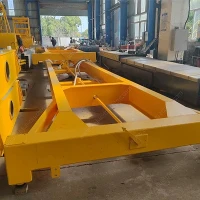
This is a fixed‑size rigid spreader beam. Eliminating complex on‑board hydraulic or electrical systems, it relies entirely on the linkage of mechanical springs and steel ropes to achieve automatic locking and unlocking of twist locks, featuring an extremely simple structure and outstanding reliability.
The spreader's self‑weight triggers the twist locks to automatically engage with the container. Unlocking is completed when lifting tension from the crane pulls the internal steel ropes. No manual intervention is required throughout the entire operation cycle, delivering stable performance in high‑frequency port handling scenarios.
Its compact design – without hydraulic cylinders and motors – requires minimal headroom, making it perfectly suited for working environments with limited vertical space, such as warehouses and small storage yards.

KEY CHARACTERISTICS
Pure mechanical drive – no hydraulic or power system required.
The beam structure primarily bears compressive load.
Fixed container size with robust construction.
Light self‑weight and low headroom requirement.
what is a electro-hydraulic container spreader
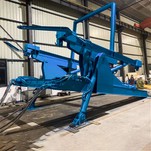
The electro‑hydraulic container spreader is a heavy‑duty telescopic spreader beam integrated with a built‑in electro‑hydraulic power unit. Its main beam is driven by hydraulic cylinders, enabling seamless size switching between 20ft, 40ft, and 45ft containers.
All core movements – including twist lock operation, side shift, and skewing – are powered by the electro‑hydraulic system, allowing one‑touch operation linked to the crane cabin. Equipped with multiple sensors and safety interlock systems for real‑time status monitoring, it serves as core equipment for efficient and safe port operations.
 KEY CHARACTERISTICS
Key Differences Between semi-automatic container spreader and electro-hydraulic container spreader
The main difference between a semi-automatic container spreader and an electro-hydraulic container spreader is how actuation and functional control are achieved. While both are container lifting spreader beam devices for ISO containers, they operate with distinct mechanical systems and are suited to different terminal lifting applications.
Electro-Hydraulic Container Spreader
Ideal for high-throughput seaports, intermodal terminals and permanent crane installations
Which Container Spreader Should You Use?
The correct choice depends on your terminal throughput, container size diversity, available headroom, automation requirements and overall lifting operation layout.
Frequently Asked Questions
FQAS
Q:1.What are the core differences between semi‑automatic and electro‑hydraulic spreaders?
A:Power source and automation level are the key distinctions. Semi‑automatic spreaders adopt a purely mechanical construction with relatively limited functions and require manual assistance. Electro‑hydraulic spreaders integrate an electro‑hydraulic drive system, featuring high automation, automatic adjustment, and precise control capabilities.
Q:2.Which type of spreader has a lower procurement cost?
A:The initial investment for a semi‑automatic spreader is generally much lower than that of an electro‑hydraulic spreader. Thanks to its simple structure – without complicated hydraulic and electrical control components – it has a lower purchasing threshold and is suitable for projects with limited budgets or low‑frequency operation.
Q:3.Can electro‑hydraulic spreaders handle containers of multiple sizes?
A:Yes. Standard electro‑hydraulic spreaders support automatic switching among 20ft, 40ft, and 45ft containers. The telescopic beam can be adjusted quickly via the electrical control system to match different sizes, greatly improving turnover efficiency.
Q:4.Is daily maintenance complicated for semi‑automatic spreaders?
A:Maintenance is extremely straightforward with low service frequency. Routine work mainly includes regular lubrication of steel wire ropes and sheave blocks, plus inspection of mechanical wear and rotational flexibility of twist locks. No professional electrical or hydraulic maintenance skills are required.
Q:5.What is the safety protection level of electro‑hydraulic spreaders?
A:They deliver excellent safety performance and comply with industrial heavy‑duty safety standards. Fitted with multiple sensors, mechanical interlocks, and hydraulic locking devices, the system verifies full engagement of twist locks before lifting is permitted – completely eliminating risks of accidental container dropping.