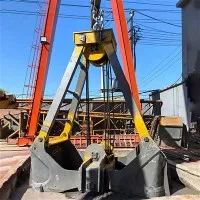
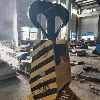
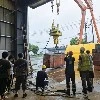
Recently, ENJUE4 sets of wireless remote-controlled grabs completed factory inspection and are officially on their way to Xindayang Shipyard. They will be used as supporting bulk carrier equipment for ships under construction at the yard. Each delivery further deepens ENJUE's presence in the field of remote-controlled grabs for bulk carriers and provides key equipment support for Xindayang Shipyard's growing shipbuilding projects.
Precisely meeting the shipyard's needs, 4 sets of radio remote control grabs are ready
The ENJUE remote-controlled grab bucket uses full hydraulic drive and wireless remote control technology, so no external power cable is needed. Operators can accurately control the bucket's opening and closing in the air from a safe distance. This remote-controlled grab is especially suitable for material handling and outfitting operations during the construction of bulk carriers. Its feature of 'closing on the ground and opening anywhere in the air' effectively avoids the collision risks that traditional grab buckets face in tight ship compartments, improving on-site safety at shipyards.
The grab bucket delivered this time has been specifically optimized for shipbuilding scenarios. It is made of high-strength wear-resistant steel plates, and its key pins and cylinders have excellent impact resistance, enabling it to handle long hours of intense work both in open shipyard areas and along the dock. At the same time, its built-in high-performance battery supports long operating times, reducing the maintenance burden of frequent recharging and matching the current full-load production pace at New Ocean Shipbuilding.
As one of the earlier domestic companies to apply wireless remote control technology in the grab bucket field, ENJUE has already gained solid experience in applications like bulk cargo handling at ports and offshore transshipment. This time, entering the mainstream shipyard supply chain of New Ocean Shipbuilding in bulk means that ENJUE remote control grab is extending from traditional port operations to supporting shipbuilding and repair.

Delivery on Site: Efficient Collaboration from Shanghai to Yangzhou
The four grabs delivered this time were debugged at the ENJUE factory and obtained the relevant class society inspection certificates. They were then transported by road directly to the Yangzhou Xindayang Shipyard. Upon arrival, the equipment had already been adapted and connected to Xindayang Shipyard's crane devices. Going forward, ENJUE's technical service team will provide operation training and maintenance guidance to ensure the equipment can be quickly put into practical use within the shipyard's production schedule.
ENJUE noted that Xindayang Shipyard, as a leading company in domestic medium-sized bulk carrier construction, has strict requirements for the operational efficiency and reliability of supporting equipment. This collaboration marks another important deployment of ENJUE's remote-controlled grab products in shipbuilding terminal scenarios. Previously, a similar ENJUE grab bucket completed on-site tests and deliveries at a Singapore port, performing steadily even under high temperatures and high salt-fog conditions.

Shipbuilding, at its core, is a race against time. From the first steel plate being cut to a 60,000-tonne bulk carrier finally leaving port, a vessel passes through countless processes, thousands of pairs of workers' hands, and innumerable lifts and sets. People tend to reserve their gaze for the grandeur of the gantry crane slowly traversing the dock, or for the moment a new ship is launched, and her bow cuts through the river's surface. But what truly holds these scenes together are the silent, repetitive, unnoticed movements of material-a bucket of ore, a skip of scrap steel, a pile of fittings that waited too long beside the berth before finally being hoisted aboard.
These four ENJUE radio remote control grabs will never appear in the photos of a delivery ceremony, but they will remember every tonne of waiting that was saved. New Dayang's order book stretches to 2029, and the river breeze will blow through many more busy springs and autumns.
Good tools are always like this: you barely notice they are there-until one day you look back at the books and realize the ship, somehow, moved faster than you imagined.